BS 6229:2025 - The key changes and implications for flat roof design
Building standards and regulations
Superseding BS 6229:2018, the 2025 revision reflects over five years of industry feedback, technical clarification, research, and regulatory alignment. It came into effect in December 2025 following an extended review by a broad technical committee comprising warranty providers, research bodies, manufacturers, trade associations and specialist consultants.
While the scope of BS 6229 remains familiar, the updated standard introduces several important clarifications, new definitions, and enhanced design obligations that materially affect how flat roofs are conceived, specified, and delivered. At its core, the new edition seeks to remove ambiguity - particularly in areas such as falls, drainage, inverted roofs, blue roofs and timber deck construction - while reinforcing a performance-led approach to durability, thermal efficiency and risk management.
Clarified scope and updated terminology
BS 6229:2025 continues to apply to flat and curved roofs with pitches up to 10°, incorporating continuously supported flexible waterproofing over concrete, metal or timber-based decks. It also recognises that its guidance may be relevant to steeper roofs and green roof constructions.
One of the most notable changes is the expansion and refinement of definitions in Section 3.
Key additions include:
- Balconies and terraces, clearly distinguished for fire-safety purposes with reference to BS 8579.
- Boards (cover boards, recovery boards and roof boards), defined by their function and position within the roof build-up.
- Emergency overflows, explicitly distinguished from overflows (tell-tales) and required to match the full hydraulic capacity of blocked outlets.
- Absolute zero fall roofs, a new term introduced specifically for blue roofs, defining a finished fall of 0° with no backfalls after tolerances and deflection are accounted for.
- Podium structures, defined to clarify ongoing fire safety debates and expressly stated not to be “specified attachments”.
- Water checks, now distinguished from short-term, non-detrimental water pooling at by membrane laps.
These definitions are not merely editorial; they underpin new technical requirements elsewhere in the standard.
Roof falls: From rule of thumb to evidence‑based design
Perhaps the most impactful change in BS 6229:2025 concerns roof falls and drainage geometry.
The long-standing guidance to “design for 1:40 to achieve a minimum 1:80” has been removed. Instead, the standard now states unequivocally that the minimum completed fall on most flat roofs is 1:80, with the design fall derived from structural analysis and/or detailed survey data, rather than generic prescription.
Key points include:
- For new build, designers must allow for construction tolerances and deck deflection through structural analysis.
- For refurbishment, a level survey (ideally presented as a contour map) is required.
- A design fall of 1:60 is now recognised as an appropriate starting point in many cases.
- A design fall of 1:40 is required only where deflection exceeds 17 mm over 1 m.
- Roofs under 50 m² may generally be designed at 1:60.
Critically, the revision reiterates that backfalls are not acceptable under any circumstances, regardless of roof type. Responsibility for addressing them rests firmly with the deck or structural slab installer—an important shift with implications for procurement and sequencing, particularly on concrete-framed projects.
Zero falls and blue roofs
The updated standard now provides much greater clarity on zero fall roofs, which are acceptable only for specific systems supported by third-party certification (typically ballasted constructions) and where no backfalls exist.
For blue roofs, the requirements are more stringent. Even minimal falls compromise hydraulic attenuation (the slowing of water run-off), so BS 6229:2025 requires absolute zero falls. This must be defined and constructed with exceptional accuracy, typically requiring near-perfect concrete decks with allowance for corrective screeding.
Sumps, outlets and emergency overflows
Drainage detailing receives increased attention in the 2025 revision, reflecting insurer concerns around water accumulation and structural loading.
For the first time, the standard introduces defined limits on sump dimensions:
- Maximum area: 0.72 m² per outlet
- Minimum size: 400 mm
- Maximum dimension: 1200 mm
These limits prevent the formation of large, virtually flat “mini roofs” around outlets. With clearly defined sump sizes , insurers now have accepted that sump bases may be flat, provided these dimensions are controlled.
In parallel, the standard strengthens requirements for emergency overflows. Roofs with a single outlet, as well as all blue roofs, must include emergency overflow provision, sized to match the full capacity of a blocked outlet. Where drainage is internal, the standard strongly encourages additional overflow routes discharging to separate downpipes. This reduces the risk of concealed flooding and potential structural overload.
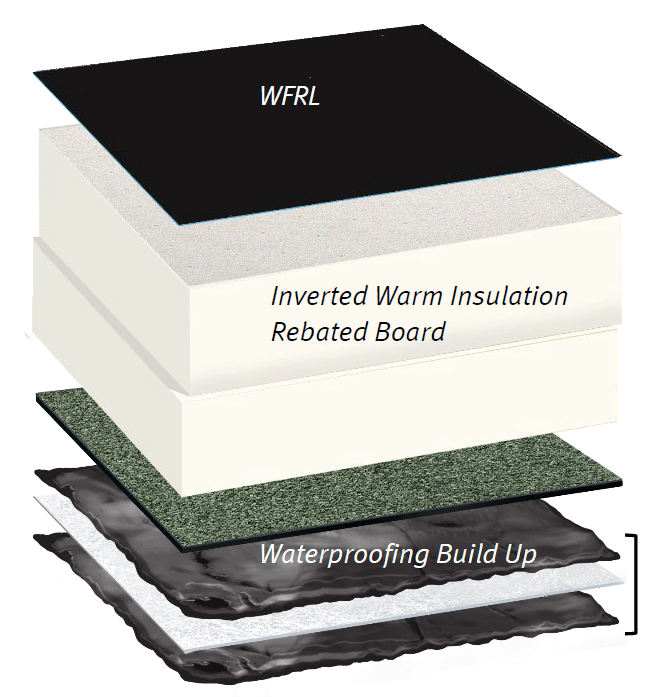
BS 6229:2025 formally recognises inverted warm roofs as a subtype of warm roof construction, while significantly strengthening guidance on thermal performance.
The revised standard highlights the variability of Water Flow Reducing Layer (WFRL) performance and introduces new obligations:
- WFRL laps should be overlapped by 300 mm or sealed where this cannot be achieved.
- Where declared and design insulation values are the same, designers should increase insulation thickness by a minimum of 2.5% to compensate for rainwater cooling effects.
For inverted warm blue roofs, the thermal challenge is even more complex. The standard acknowledges that existing test methods do not adequately account for prolonged head of water. As a result, Annex A introduces a pragmatic correction method, applying a default F‑factor of 0.75 during days when the roof operates in attenuation mode. Worked examples demonstrate that additional insulation thickness can vary significantly by location, with much greater corrections required in wetter climates such as Glasgow.
U values and “at any point” performance
A further critical clarification relates to thermal continuity which is also covered in the Building Regulations of the respective Nations. BS 6229:2025 explicitly states that the maximum permitted U‑value (the rate of heat loss through a building element) at any point on a heated roof is 0.35 W/m²K (0.30 W/m²K for New Build in Northern Ireland).
The phrase “at any point” is deliberate and consequential, capturing:
- Tapered insulation low points
- Gutter soles
- Minimum insulation zones around outlets (including sumps) and penetrations
This removes the practice of offsetting poorly insulated areas against better-performing zones elsewhere on the roof.
Cross Laminated Timber (CLT): Cautious Integration
Responding to the increasing use of Cross Laminated Timber decks, BS 6229:2025 introduces strict guidance developed with the Structural Timber Association. Designers are explicitly encouraged to design out CLT flat roof decks wherever possible.
Where unavoidable, the standard requires:
- The deck to be at a minimum finished fall of 1:40
- Factory-applied end‑grain sealing
- No rebated deck joints
- Protection from moisture during transport and construction
- Moisture content below 20 % before waterproofing
- Explicit consultation with waterproofing manufacturers where protective membranes are used
This represents one of the clearest shifts in tone, moving from accommodation to active risk avoidance.
Fire, Maintenance and Information Exchange
Other notable changes include:
- Clarified guidance on external fire performance, particularly for green roofs and pedestal‑supported paving, with reliance placed on established notional designations.
- A new section on Exchange of Information and Project Schedule, emphasising early co-ordination and sequencing
- Expanded care and maintenance guidance, including deconstruction, recycling, and the retrofit of photovoltaic (PV) systems.
Nigel Blacklock, Standards and Compliance Director BS 6229:2025 is not simply a technical update; it represents a more rigorous, evidence-based approach to flat roof design.
The key messages are clear: design falls intentionally and verify them, manage water carefully, quantify thermal risk realistically, and treat emerging materials with caution.
While the minimum completed fall remains broadly unchanged, the responsibility for achieving it has shifted decisively toward informed analysis rather than convention, and in New Build provision of a flat level substrate is with the deck/slab provider.
For designers and specifiers, the revision demands greater precision, but ultimately offers greater confidence in performance, insurability and long-term durability.”