Understanding Scope 1, 2 & 3 Emissions Banner
BauderTALKS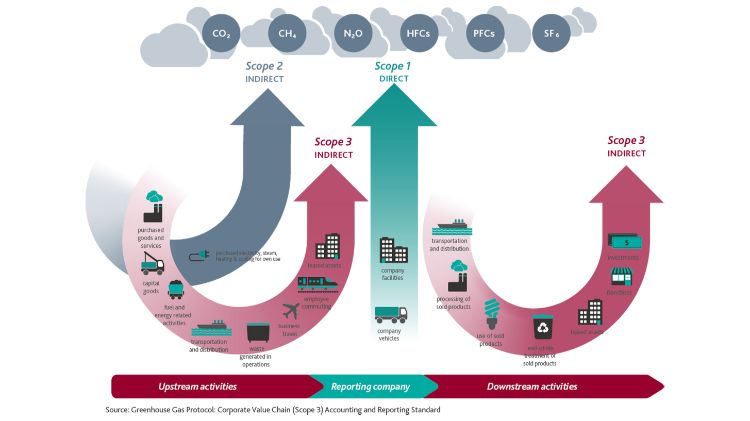
As the UK construction industry works to meet the goal of net-zero greenhouse gas (GHG) emissions by 2050 (and interim targets), professionals across the sector must deepen their understanding of these emissions: where they come from, who is responsible for them, and how to reduce them.
Central to this is the Scope 1, 2 and 3 emissions framework, which provides a clear structure for identifying and managing carbon emissions throughout a project’s lifecycle. Understanding the flow of emissions across the supply chain is key, especially regarding embodied carbon’s influence on an organisation’s total footprint and how to reduce it.
Defining Scope 1, 2 & 3 emissions
These categories, defined by the Greenhouse Gas Protocol, were formed to provide a standardised framework for measuring and reporting GHG emissions. The three scopes may be explained as follows:
- Scope 1: Direct emissions from owned or controlled sources, such as fuel combustion on site, company-owned plant and vehicles
- Scope 2: Indirect emissions from purchased electricity, heating, or cooling
- Scope 3: All other indirect emissions in the value chain; for example, raw material extraction, manufacturing of building products, transportation, and waste
For construction projects, Scope 3 emissions typically represent the largest portion of total emissions; yet they are the most difficult to influence directly.
From manufacturer to client: Whose emissions are they?
It can be confusing for organisations to understand or be aware of which emissions they are accountable for.
A central concept in aiding our understanding of carbon accounting is that one organisation’s Scope 1 emissions are another’s Scope 3.
Consider this example:
- A manufacturer producing insulation or structural materials will generate Scope 1 emissions through fuel use, high-heat processes, and material transformation.
- These emissions, alongside their Scope 2 (electricity) and upstream Scope 3 (raw material extraction), are embedded in the embodied carbon of their products.
- When a construction client procures these materials, that embodied carbon becomes part of their Scope 3 emissions; even though the client didn’t produce the emissions directly.
This shared accountability highlights the importance of selecting suppliers that actively reduce their own emissions.

GHG Protocol scopes and emissions across the value chain (Source: WRI/WBCSD Corporate Value Chain (Scope 3) Accounting and Reporting Standard).
Reducing scope 3 emissions: The challenge
Scope 3 emissions are complex and reducing them is a challenge because they fall outside the direct control of the construction firm or client. They depend on the emissions performance of several other parties, including:
- product manufacturers
- material suppliers
- logistics providers
- installation subcontractors
- waste processors
Yet despite this challenge, Scope 3 offers the biggest opportunity for impact, especially in the early design and procurement stages.
How organisations can reduce their scope 3 emissions
In its annual greenhouse gas emissions report for 2023-24, East Sussex County Council recorded Scope 3 emissions that were over 30 times greater than its Scope 1 and 2 emissions combined. This is common for many organisations, and while it might sound like cause for concern, it also represents an opportunity.
Here’s how organisations can reduce their scope 3 emissions.
A. Responsible, environmentally focused procurement
By integrating environmental considerations into procurement processes, supplier selection and materials, organisations (especially those in the construction industry) can dramatically reduce whole-life carbon (i.e. all GHG emissions over a building’s life cycle, from construction, operation and maintenance to demolition or reuse).
Choosing manufacturers that produce low-carbon products can lead to significant reductions in Scope 3 emissions and, therefore, overall project emissions.
For example:
• A low-carbon concrete mix or recycled steel can cut embodied carbon by up to 50%.
• Timber sourced from certified sustainable forests can result in net carbon storage, depending on the lifecycle accounting.
• Insulation made using bio-based or recycled materials can reduce upstream emissions while delivering the same performance.
These decisions have an outsized positive impact because embodied carbon often accounts for 20–70% of a building’s lifecycle emissions.
The following example demonstrates how Scope 3 emissions for a refurbishment project were significantly reduced through the procurement of an innovative roofing insulation product.
Lewisham Park Towers: How responsible procurement led to Scope 3 reductions
Central to the large-scale roof refurbishment of Lewisham Park Towers in London was the use of Bauder’s innovative ECO FF insulation boards. As a direct result of incorporating environmental considerations into its choice of roofing insulation, Bauder client L&Q Group achieved a carbon emissions reduction of 10.96 tonnes of carbon dioxide equivalent (tCO₂e) – approximate to the emissions from 18,000 air miles, or a commercial return flight from London to Sydney.
So, how were these carbon emissions achieved?
One of the most effective dual-impact strategies in construction is using low-carbon insulation, like Bauder’s ECO FF. The reason for this lies in the following two points:
- Reduced embodied carbon: Choosing products made from recycled, renewable, or low-impact materials reduces the carbon emitted during production. ECO FF is produced using the biomass-balance approach. As a result, the boards contain up to 80% less embodied carbon than traditional polyisocyanurate (PIR) insulation.
- Reduced operational emissions: High-quality insulation improves thermal performance, lowering heating and cooling needs throughout a building’s life. L&Q Group, by selecting Bauder’s ECO FF insulation, increased the Lewisham Park Towers buildings’ thermal efficiency. In turn, the reduction in heating and cooling needs has created positive, enduring social sustainability outcomes such as warmer homes and reduced energy bills for residents.
This double benefit contributes to both immediate carbon savings at the point of construction and long-term operational efficiency, important for meeting whole-life carbon goals.
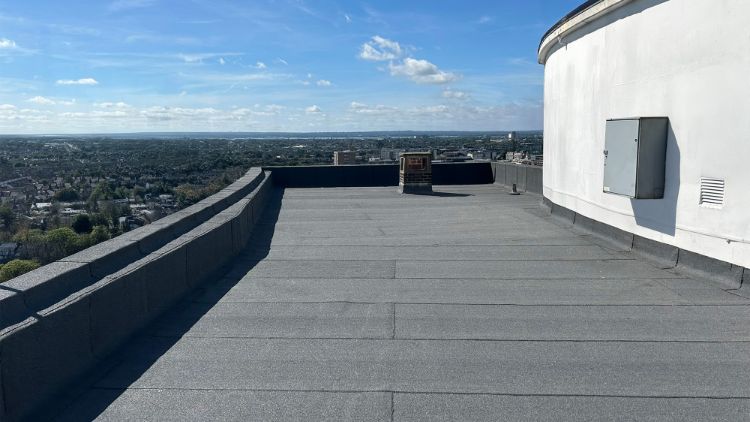
Bauder's Lewisham Park Towers refurbishment project
B. The circular economy, durability and longevity
The circular economy is an economic model that, when applied to construction, encourages designing buildings in ways that minimise waste and extend their lifecycle through durability.
A significant reduction in a building’s lifetime emissions can be achieved in the first instance by using well-designed, durable products that stand the test of time. This reduces:
- the need for replacement materials
- maintenance-related emissions
- waste and end-of-life processing
In short, durable design reduces the need for future resource inputs, which translates into fewer emissions over the building’s lifetime. This is especially relevant for elements like cladding, roofing, windows, and HVAC systems.
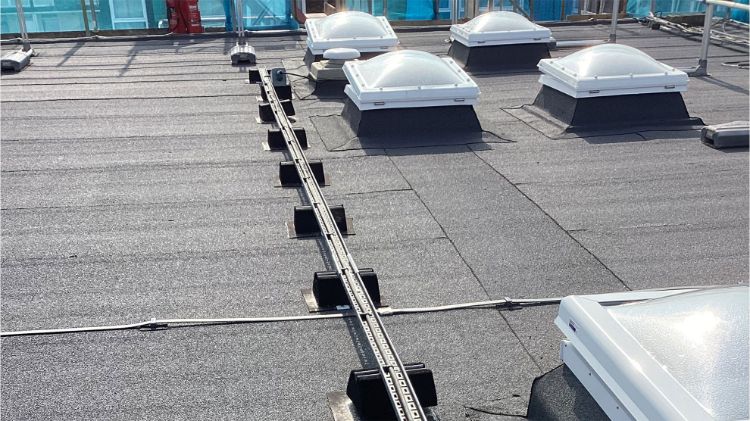
Bauder's Kiln Place roof refurbishment project
Kiln Place: Circular economy in practice
One of the five principles of the circular economy is to minimise impact and waste. An example of this principle in practice is the Kiln Place roof refurbishment in Camden, London.
This mixed tenure residential block’s roof had experienced leaking and required capital works. Bauder undertook an extensive moisture mapping survey using a Troxler gauge to understand the overall condition of the roof and underlying insulation.
The results of the survey showed that 90% of the existing insulation was dry, sound and did not need replacing. Therefore, the project’s material requirements and waste from the site were greatly reduced. Existing waterproofing and insulation components could be retained, and less roofing material became landfill waste.
In addition, by undertaking a moisture mapping survey, Bauder client Mulalley & Co Ltd saved over £100,000 from the original budget and benefitted from a shorter project completion time.
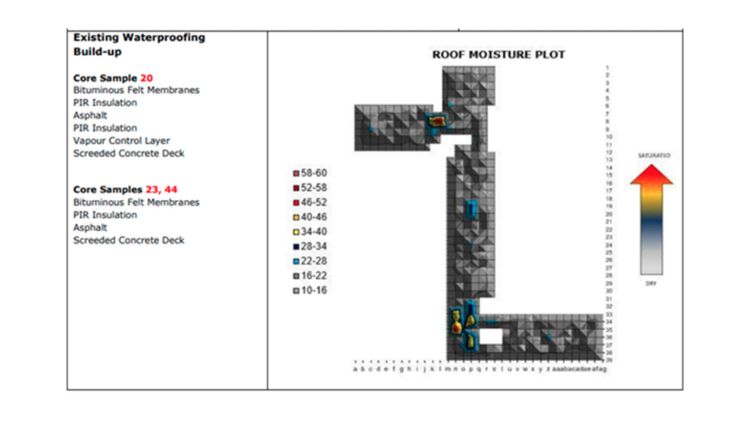
Existing waterproofing build-up
Tom Raftery, Head of Sustainability From a material perspective, approximately 67 metric tonnes of roofing material and insulation was prevented from being sent to landfill, which equates to over 6.4 tCO2e emissions savings. When the embodied carbon of the insulation material not required is also factored in, this total rises to approximately 26 tCO2e saved.
Change through collaboration and responsible procurement
Tackling construction emissions requires more than just onsite efficiencies; it demands a collaborative, informed approach to procurement, design, and product selection. By understanding how manufacturer emissions become part of your Scope 3, and by carefully considering material procurement decisions, construction professionals can drive meaningful change toward a low-carbon future.
Key points for Construction Professionals
- Understand where emissions occur across your value chain using Scope 1, 2, and 3 categories
- Recognise that your Scope 3 is someone else’s Scope 1, and use this knowledge to engage with your supply chain
- Target embodied carbon reductions early in the project through smart material choices and efficient design/data analysis
- Specify low-carbon insulation for immediate and lifetime benefits
- Prioritise longevity and quality to reduce future emissions and resource use

Want to find out more?
Each project is unique in its requirements, and we have lots of resources and examples of our work to help guide you. If you are looking for a flat roofing solution for a new build or refurbishment project, then contact our team to discuss your project’s needs.