SUBSTRATE SUITABILITY
Practical Checks
If it looks wet, feels wet, appears wet – it is unlikely to be dry!
Apply a tissue to the surface and ensure dry when removed.
Moisture Content (cementitious materials)
Prior to overlay with the Bauder LiquiTEC Balcony, Walkway & Terrace systems, the equilibrium moisture content of the substrate must not exceed 6% by weight or 75% RH.
Ensure that moisture will not come into contact with the underside of the coating due to structural conditions. The Bauder LiquiTEC Balcony, Walkway & Terrace System is not a Damp proof membrane.
Measured Checks
Carry out RH test in accordance with British Standard using a suitable hygrometer (e.g. GE Protimeter MMS). Please note this is a non-destructive method but lacks accuracy.
Carry out equilibrium moisture test with CM tester. This is a destructive method to check the actual moisture content of the sample.
Practical Advice
Lower Risk Scenarios
- Refurbishment (hydration complete)
- If the surface is closed with few voids e.g. power floated
- If the substrate is white / light grey
- If the substrate looks impermeable
- If there is no buried membrane or permanent formwork
- If the substrate has previously been waterproofed
- If the cementitious material is polymer modified
- If the area has good falls
- If the area is under cover
Higher Risk Scenarios
- New build (hydration incomplete – green concrete)
- Sand and cement screeds
- Anything brown
- If the surface is open with voids
- If the substrate looks porous / contains porous aggregates (lytag)
- If there is a buried membrane* or permanent formwork
- If the substrate has never previously been waterproofed
- If the area has poor falls
- If the area is exposed
Practical Checks
Dry core and break the sample or simply remove a sample (hammer and chisel) and observe apparent moisture levels at the surface and deeper within the build up. If anything looks damp / wet do not proceed.
Use adhesion testing / observation of primer coat.
Prepare and prime an area and look for:
- Blisters
- Blooming / milkiness
- Adhesion: If a risk is perceived set a limit for adhesion higher than standard (e.g. 2.0N/mm²)
Minimising the Risk
Prime the higher risk areas first, but leave as long as possible before overlaying.
If the primer shows any of the problems listed above, the substrate is not sufficiently dry.
Specific Advice for New Concrete
Consult the engineer / concrete supplier for details of the mix and the estimated hydration times.
Allow minimum 28 days.
Hardness
Substrates should achieve a minimum hardness of 25N/mm².
Measured Checks
Carry out compressive strength tests with a “Schmidt” hammer.
Practical Checks
With particular regard to cementitious substrates, if the surface is not friable, cannot be eroded with the heel of a shoe, does not feel soft or crumbly, the compressive strength is likely to be higher than 25N/mm².
If the existing substrate is trafficked and has been subjected to point loadings without indentation then it is likely to be suitable for overlay with a trafficable system.
Substrate Preparation
Basic Requirements
- The substrate must be clean, dry and free from dust, laitance, grease, oil and any other contaminants.
- Where there are existing coatings, paints or sealers fully remove (or carry out on site adhesion tests to determine suitability for overlay).
Initial Cleaning Equipment / Methods
Pressure Washer (2,000 psi)
- Washing down / organic growth removal.
Typical Preparation Equipment
- Brushing – use of a stiff brush for removal of dirt and dust.
- Scarifier – for de-chipping/preparation of certain cementitious materials etc.
- Open shot blasting – for coating removal/cementitious materials/asphalt.
- Hand grinder (diamond / carbide) – for detail preparation.
- Sanding – for detail preparation/metals/plastic/certain single ply membranes.
Substrate Preparation & Priming Schedule
| Substrate | Preparation Notes | Main Area | Details |
|---|---|---|---|
| Paving grade asphalt | 1 / 8 | LiquiPRIME 1 | LiquiPRIME 1 |
| Roofing grade asphalt | 1 / 8 | Unsuitable substrate. Remove if present | LiquiPRIME 1 |
| Hot rolled / Stone mastic asphalt | 1 / 8 / 10 | LiquiPRIME 1 | LiquiPRIME 1 |
| Oxidised bitumen membrane | 2 / 9 | Unsuitable substrate. Remove if present | LiquiPRIME 1 exposed bitumen only |
| SBS modified bitumen membrane | 2 / 9 | Unsuitable substrate. Remove if present | LiquiPRIME 1 to exposed bitumen only |
| APP modified bitumen membrane | 2 / 9 | Unsuitable substrate. Remove if present | LiquiPRIME 1 to exposed bitumen only |
| Bitumen | 2 | Unsuitable substrate. Remove if present | LiquiPRIME 1 |
| Concrete / Screed / Brickwork | 1 / 5 | LiquiPRIME 2 | LiquiPRIME 2 |
| Porous concrete | 1 / 5 | Cryl Primer 287 | Cryl Primer 287 |
| Concrete with 6-10% equilibrium moisture content | 1 | Seek Bauder advice | Seek Bauder advice |
| Lightweight concrete / render | 1 | Seek Bauder advice | Seek Bauder advice |
| Polymer modified concrete | 1 / 5 | LiquiPRIME 2 | LiquiPRIME 2 |
| Blockwork (porous) | 1 / 5 | LiquiPRIME 2 at 0.6Kg/m² with maximum catalyst + 1% Liquid Thixo | LiquiPRIME 2 at 0.6Kg/m² with maximum catalyst + 1% Liquid Thixo |
| Steel | 3 | No primer required | No primer required |
| Galvanised steel | 3 | No primer required | No primer required |
| Stainless steel | 3 | No primer required | No primer required |
| Aluminium | 3 | No primer required | No primer required |
| Copper | 3 | No primer required | No primer required |
| Zinc | 3 | No primer required | No primer required |
| Lead | 3 | No primer required | No primer required |
| Glass | 3 | No primer required | No primer required |
| Wood / timber / ply | 2 | LiquiPRIME 1 | LiquiPRIME 1 |
| EPDM | 2 / 6 | Special Primer 610 | Special Primer 610 |
| Single ply membranes - CPE | 3 / 7 | No primer required | No primer required |
| Single ply membranes - EVA | 2 / 7 | No primer required | No primer required |
| Single ply membranes - PIB | 2 / 7 | No primer required | No primer required |
| Single ply membranes - PVC-P, nB | 3 / 7 | No primer required | No primer required |
| Other single-ply membranes | Subject to testing | Subject to testing | Subject to testing |
| UPVC / PVC | 3 | No primer required | No primer required |
| GRP | 3 | No primer required | No primer required |
| Acrylic Glass | 3 | No primer required | No primer required |
| PU (polyurethane) | 4 / 6 | No primer required | No primer required |
| PMMA (poly methylmethacrylate) | 4 / 6 | No primer required | No primer required |
| UP (polyester) | 4 / 6 | No primer required | No primer required |
| EP (epoxy) | 4 / 6 | No primer required | No primer required |
| Other substrates / plastics / mouldings | Subject to testing | Subject to testing | Subject to testing |
Preparation Notes
- Scarify, grind or lightly bead blast.
- Scrape and sweep away contamination and clean by power washing (with or without approved detergent) as required.
- Rub down thoroughly with Bauder PMMA Cleaner and abrade / grind metals and hard plastics to achieve a roughened surface. (Steel must be ground or blasted to bright metal – where all rust cannot be practically removed, use “Hammerite No.1 Rustbeater” prior to the application of the Bauder system products).
- Lightly abrade and carry out an adhesion test as described in this manual.
- The equilibrium moisture content of cementitious materials must not exceed 6% or 75% RH. Where moisture levels are in excess of these values seek advice from Bauder regarding possible use of Pox R106.
- Subject to testing of insitu material and approval by Bauder Technical Team.
- Where large areas are to be treated, test areas to be carried out to ensure ruckling does not occur.
- Blisters and high spots should be cut away using a grinder. Do not heat and trowel.
- Loose areas and blisters to be cut away.
- For HRA and SMA, increase primer consumption by 50% and use 6% catalyst.
Where there are any doubts as to adhesion, preparation or substrate stability carry out adhesion tests as described in this manual.
For other substrates, consult the Bauder Technical Department on 01473 257671 for required preparation methods and priming.
The Importance of Adhesion
The system should achieve a minimum bond to the substrate of:
- Cementitious materials / metals / plastics / hard substrates: 1.50N/mm²
- Asphalt and other substrates: 0.80N/mm²
- Unbonded / loose laid substrates where pull off tests not possible (membranes): Peel strength adhesion 30N/50mm
Measured Checks
Carry out pull off tests using minimum 50mm dollies and carefully assess results.
Carry out DIN EN 12316 peel strength adhesion tests.
Practical Checks
Carry out pull off tests using minimum 50mm dollies and calibrated hydraulic test rig and carefully assess results.
Carry out on site peel tests.
After applying a test area of LiquiBALKON or LiquiDETAIL (and recommended primer if required), cut a circular hole through the Bauder coating and upper layers of the substrate with a hole saw. Adhere 50mm dolly to the surface of the Bauder coating within the cut area and allow adhesive to cure. Carry out adhesion test with calibrated hydraulic test rig.
Peel Test Method
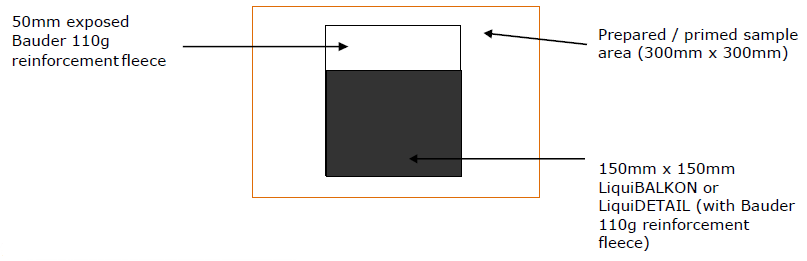
Carry out adhesion tests as illustrated below:
Waiting Times before Peeling
| Substrate | Waiting Time |
|---|---|
| Synthetic single ply membranes | min. 3 hours |
| Coated materials e.g. metals | min. 3 hours |
| Cementitious materials | min. 3 hours |
| Bituminous materials | min. 3 hours and ideally after 72 hours due to lower initial adhesion |
Peel Method
Hold the exposed fleece and pull slowly at 90 degrees to the substrate.
Assessment
| Mode of Failure | Assessment |
|---|---|
| Cannot be removed | Satisfactory adhesion |
| Fleece tears | Satisfactory adhesion |
| Interlayer delamination of LiquiBALKON / LiquiDETAIL | Satisfactory adhesion |
| LiquiBALKON / LiquiDETAIL difficult to remove and removes top layer of homogenous substrate (not coating) | Satisfactory adhesion |
| LiquiBALKON / LiquiDETAIL easy to remove with little or no membrane left on substrate, or substrate left on membrane | Poor adhesion – re-test using different preparation / primer combinations and leave for a minimum of 72 hours |
| LiquiBALKON / LiquiDETAIL easy to remove and removes coating (paint etc.) from coated substrate | Poor adhesion – remove coating from substrate and re-test |