LiquiTEC System Overview and Main Attributes
What is Bauder LiquiTEC Cold Liquid Applied Roof System?
The Bauder LiquiTEC Cold Liquid Applied Roof System combines catalyst activated PMMA based liquid resins and polyester reinforcement fleece to form a fast curing, tough and durable roof waterproofing membrane, which can be used in both new build and refurbishment flat roof applications directly to a variety of substrates and existing waterproofing materials. It is also possible to incorporate warm roof insulation into the system.
The system comprises:
Bauder LiquiPRIME 1 (if required) – resin for priming timber, asphalt, bitumen and APP felt.
Bauder LiquiPRIME 2 (if required) – resin for priming cementitious materials, brickwork and blockwork etc.
Bauder LiquiPASTE (if required) – resin for repairing cracks and holes in the substrate.
Bauder PMMA Cleaner – for cleaning metal and plastic substrates, re-activating previously applied resin and cleaning tools. Supplied in screw top metal containers.
Bauder LiquiDETAIL – resin for waterproofing upstands and details.
Bauder LiquiFIBRE – resin for waterproofing awkward shapes and areas where access is restricted.
Bauder LiquiDEK – resin for waterproofing main roof areas.
Bauder 110g reinforcement fleece – reinforcement fleece for LiquiDEK and LiquiDETAIL, available in various convenient widths of 50M long rolls.
Catalyst – powder to be added to resins prior to application to trigger the curing process. Supplied in small polybags or larger bags (0.1kg, 1.0kg and 25kg).
Anti-skid granules (if required) – for non-slip finish.
Bauder Quartz (if required) – a heavy duty wearing layer for areas such as fire escape routes or maintenance walkways.
Bauder LiquiFINISH (if required) - finish coat resin, used to provide alternative colours, or when anti-skid granules or wearing layer is required.
Liquid Thixo (if required) – Thixotropic agent for use as an additive to LiquiPRIME and LiquiFINISH when treating upstands over 250mm high. Can also be used with LiquiDEK when waterproofing sloped roofs over 10°.
The resins are packaged in re-sealable metal containers which will be supplied separately or on pallets.
What is PMMA?
PMMA is an abbreviation for Poly Methyl Methacrylate. Methyl Methacrylate (MMA) was first synthesised in 1903, with the first practical and commercial applications coming in the early 1930‘s. It was originally used for dentures due to its low water absorption, lack of toxicity and dimensional stability, and then during the Second World War for aircraft windshields (Plexiglas). Plexiglas and its derivatives are still used today - half the weight and 17 times stronger than glass. MMA has been used since the 1950’s for bone cements, dental cements and fillings, and was later used to make contact lenses.
System Overview and Main Attributes
In construction, the development of MMA for use in flooring goes back to the 1960’s. The resins and systems were designed to be:
- Impact resistant;
- Abrasion resistant and resistant to mechanical wear;
- Impermeable to liquids;
- Hygienically safe;
- Highly durable;
- Resistant to chemicals and weathering;
- Non-sensitive to humidity;
- Easy to overcoat;
- Variable in colour and design characteristics;
- Usable over wide temperature range.
By introducing flexibility and other properties into the MMA (PMMA) resins, flooring systems were developed into other applications in the 1970's
PMMA roofing systems now have a greater than 20 year track record.
Why use a reinforcement fleece?
Whatever the elastomeric properties, any un-reinforced, fully bonded liquid applied material will have difficulty in bridging unforeseen cracks. As movement occurs, the system remains fully bonded either side of the crack. The movement must be accommodated within the free width of the membrane over the crack and within the thickness of the system. See diagram below.
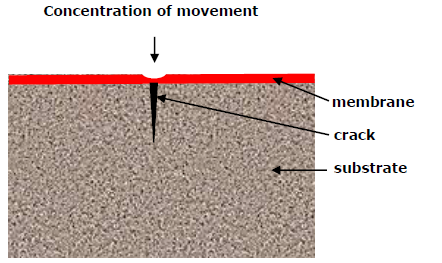
Concentration of movement
- Membrane remains fully bonded either side of crack
- Membrane will thin out over crack prior to failure
- Elastomeric properties will become irrelevant
- The unique elastomeric waterproofing resins, Bauder LiquiDEK and LiquiDETAIL, in conjunction with the special Bauder 110g reinforcement fleece provides the system with:
- Exceptional long-term resistance to regular and unforeseen movement.
- Exceptional long-term resistance to flexural fatigue.
The Bauder 110g reinforcement fleece helps the Bauder LiquiTEC system to achieve the following technical characteristics:
- Tensile Strength: c.a 6.50 N/mm²
- Inter Layer Adhesion: c.a 3.30 N/mm²
- Adhesion to Substrate: min – 0.80 N/mm² max – 2.50 N/mm²
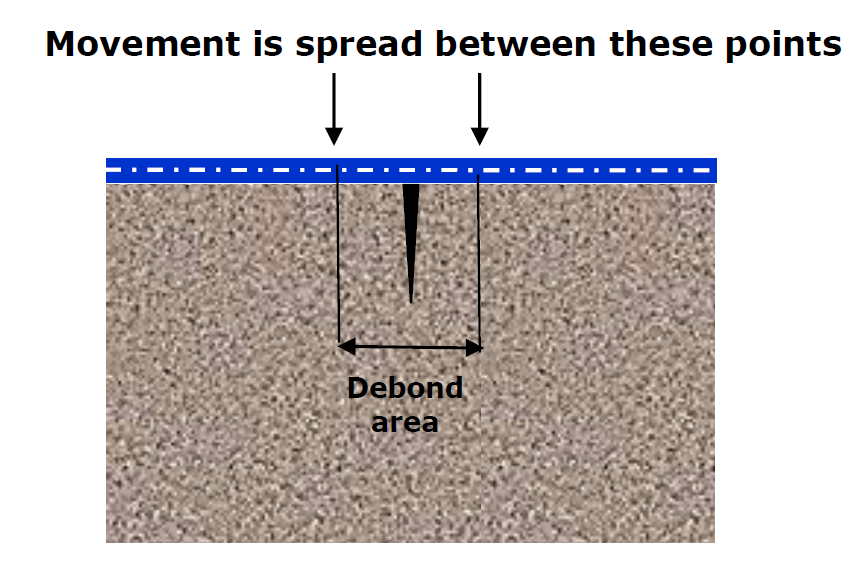
The diagram below shows the positive effect of the Bauder 110g reinforcement fleece.
- The membrane de-bonds when movement is excessive: It is easier to break the bond to the substrate than tear the membrane
- This allows a greater free width of membrane to provide the required elastomeric properties