Membrane Application
Manual Sections
Doing the details first
Typically, hot melt monolithic rubberized bitumen systems are installed, by first waterproofing the details of the deck i.e. upstands, outlets etc., before applying the membrane to main field area of the deck.
Methods of Detailing Upstand abutments and Vertical Walls
Standard method using Hot Melt
Trowel Method
- The membrane is first poured carefully into the nick of the upstand. Using a 3mm x 200mm x 300mm plywood spreader. The molten Bakor 790-11 is then drawn up the upstand in a series of passes. With each pass, the first layer of membrane is built up to 3mm in thickness.
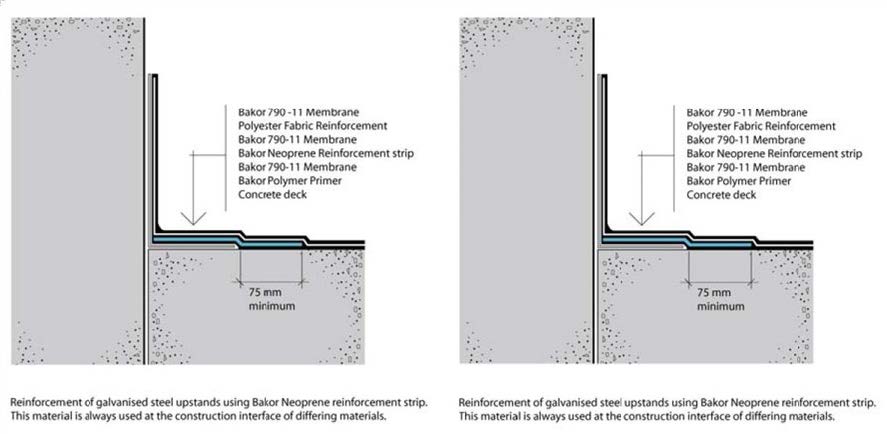
- The relevant reinforcement is then bedded into the membrane whilst it is still hot. Where the upstand is monolithic concrete, block or brickwork, the reinforcement will be the polyester fleece. Where the upstand is formed in metal, timber, plywood or any other material, the reinforcement will be Neoflash part-cured neoprene.
- The second 3mm layer of Bakor 790-11 membrane is then applied using the same method as previously described.
- The specified Bauder access/protection sheet is then fully bedded into the Bakor 790-11 membrane while it is still HOT.
- The laps of the access/protection layer are torch sealed.
- During the application of each layer of Bakor 790-11 membrane, sufficient membrane must allowed for, to enable 2 x 3mm layers of membrane, incorporating the reinforcement to be spread out onto the deck to a minimum width of 150mm.
- The edges to be “feathered” down to allow for the smooth monolithic jointing with the membrane applied later to the main deck.
Roller Method
- This method is generally only used on high walls, tree pits etc that it requires the Hot melt compound to be applied above shoulder height.
- Two 3 mm layers of Bakor 790-11 membrane, sandwiching the relevant reinforcement are applied by large nap rollers in a similar manner to the trowel method.
- The hot membrane is contained in a trough type container at the base of the vertical surface.
Two Layer Torch applied SBS Membrane Upstand Flashing Option – To be used only with prior written Agreement from Bauder Technical Department.
Cannot be used in ‘Torch-Free’ zones, only to be used in ‘Torch-Safe’ zones.
There will be exceptional occasions where, for reasons such as health and safety or limited access, the installation of a complete Bakor membrane system to all detail areas of a roof might be impractical.
In these circumstances and at the discretion of Bauder Ltd; the following method of detailing will be acceptable to us for warranty purposes.
- Bauder EGV 3.5 glass based, elastomeric bitumen, underlayer to be fully bonded to the upstands, by torch application. Side laps to be 80 mm. A neat bead of bitumen must be extruded out along all the laps.
- Bauder EGV 3.5 base sheet must be dressed down the upstands and out onto the deck by a minimum of 150mm.
- Bauder AP2 / K4E, polyester based, elastomeric bitumen, mineral surfaced protection sheet to be fully bonded to the EGV 3.5 base sheet by torch application. Side laps to be 80 mm, and a neat bead of bitumen must extruded out along all the laps.
- Bauder AP2 / K4E protection sheet must be dressed down the upstands and out onto the deck, overlapping the Bauder EGV 3.5 by a minimum of 100 mm.
- Termination Bar - used to fix and retain the waterproofing and access/protection that terminates on a vertical plane and usually protected by a metal or lead counter-flashing. Fixings to be at a minimum 300mm centres. Bauder Mastic sealant to be applied in a neat bead along the top edge of the termination bar.
Two Layer SBS Membrane Upstand Flashing Option – To be used only with prior written Agreement from Bauder Technical Department.
Cannot be used in ‘Torch-Free’ zones, only to be used in ‘Torch-Safe’ zones.
There will be exceptional occasions where, for reasons such as health and safety or limited access, the installation of a complete Bakor membrane system to all detail areas of a roof might be impractical.
In these circumstances and at the discretion of Bauder Ltd; the following method of detailing will be acceptable to us for warranty purposes.
- Bauder Sprint Duo glass based, elastomeric bitumen, underlayer to be fully bonded to the upstands, by self-adhesive application. Side laps to be 100 mm. A neat bead of bitumen must be extruded out along all the laps
- Bauder Sprint Duo base sheet must be dressed down the upstands and out onto the deck by a minimum of 150mm.
- Bauder AP2 / K4E polyester based, elastomeric bitumen, mineral surfaced protection sheet to be fully bonded to the Sprint Duo base sheet by torch application. Side laps to be 80 mm, and a neat bead of bitumen must be extruded out along all the laps.
- Bauder AP2 / K4E protection sheet must be dressed down the upstands and out onto the deck, overlapping the Bauder Sprint Duo by a minimum of 100 mm.
- Termination Bar - used to fix and retain the waterproofing and access/protection that terminates on a vertical plane and usually protected by a metal or lead counter-flashing. Fixings to be at a minimum 300mm centres. Bauder Mastic sealant to be applied in a neat bead along the top edge of the termination bar.
Two Layer Self-Adhesive SBS Membrane Upstand Flashing Option – To be used only with prior written Agreement from Bauder Technical Department.
Can be used in ‘Torch-Free’ zones and ‘Torch-Safe’ zones.
There will be exceptional occasions where, for reasons such as health and safety or limited access, the installation of a complete Bakor membrane system to all detail areas of a roof might be impractical.
In these circumstances and at the discretion of Bauder Ltd; the following method of detailing will be acceptable to us for warranty purposes.
- Bauder Sprint Duo glass based, elastomeric bitumen, underlayer to be fully bonded to the upstands, by hot-air welding application. Side laps to be 100 mm. A neat bead of bitumen must be extruded out along all the laps.
- Bauder Sprint Duo base sheet must be dressed down the upstands and out onto the deck by a minimum of 150mm.
- Bauder KSN or KSO-P SN polyester based, elastomeric bitumen, mineral surfaced protection sheet to be fully bonded to the Sprint Duo base sheet by torch application. Side laps to be 80 mm, and a neat bead of bitumen must be extruded out along all the laps.
- Bauder KSN or KSO-P SN protection sheet must be dressed down the upstands and out onto the deck, overlapping the Bauder Sprint Duo by a minimum of 100 mm.
- Termination Bar - used to fix and retain the waterproofing and access/protection that terminates on a vertical plane and usually protected by a metal or lead counter-flashing. Fixings to be at a minimum 300mm centres. Bauder Mastic sealant to be applied in a neat bead along the top edge of the termination bar.
Two Layer SBS Membrane Upstand Flashing Option – To be used only with prior written Agreement from Bauder Technical Department.
Cannot be used in ‘Torch-Free’ zones, only to be used in ‘Torch-Safe’ zones.
There will be exceptional occasions where, for reasons such as health and safety or limited access, the installation of a complete Bakor membrane system to all detail areas of a roof might be impractical. In these circumstances and at the discretion of Bauder Ltd; the following method of detailing will be acceptable to us for warranty purposes.
- Bauder Sprint Duo glass based, elastomeric bitumen, underlayer to be fully bonded to the upstands, by self-adhesive application. Side laps to be 100 mm. A neat bead of bitumen must be extruded out along all the laps
- Bauder Sprint Duo base sheet must be dressed down the upstands and out onto the deck by a minimum of 150mm.
- Bauder AP2 / K4E polyester based, elastomeric bitumen, mineral surfaced protection sheet to be fully bonded to the Sprint Duo base sheet by torch application. Side laps to be 80 mm, and a neat bead of bitumen must be extruded out along all the laps.
- Bauder AP2 / K4E protection sheet must be dressed down the upstands and out onto the deck, overlapping the Bauder Sprint Duo by a minimum of 100 mm.
- Termination Bar - used to fix and retain the waterproofing and access/protection that terminates on a vertical plane and usually protected by a metal or lead counter-flashing. Fixings to be at a minimum 300mm centres. Bauder Mastic sealant to be applied in a neat bead along the top edge of the termination bar.
Two Layer Self-Adhesive SBS Membrane Upstand Flashing Option – To be used only with prior written Agreement from Bauder Technical Department.
Can be used in ‘Torch-Free’ zones and ‘Torch-Safe’ zones.
There will be exceptional occasions where, for reasons such as health and safety or limited access, the installation of a complete Bakor membrane system to all detail areas of a roof might be impractical. In these circumstances and at the discretion of Bauder Ltd; the following method of detailing will be acceptable to us for warranty purposes.
- Bauder Sprint Duo glass based, elastomeric bitumen, underlayer to be fully bonded to the upstands, by hot-air welding application. Side laps to be 100 mm. A neat bead of bitumen must be extruded out along all the laps
- Bauder Sprint Duo base sheet must be dressed down the upstands and out onto the deck by a minimum of 150mm.
- Bauder KSN or KSO-P SN polyester based, elastomeric bitumen, mineral surfaced protection sheet to be fully bonded to the Sprint Duo base sheet by torch application. Side laps to be 80 mm, and a neat bead of bitumen must be extruded out along all the laps.
- Bauder KSN or KSO-P SN protection sheet must be dressed down the upstands and out onto the deck, overlapping the Bauder Sprint Duo by a minimum of 100 mm.
- Termination Bar - used to fix and retain the waterproofing and access/protection that terminates on a vertical plane and usually protected by a metal or lead counter-flashing. Fixings to be at a minimum 300mm centres. Bauder Mastic sealant to be applied in a neat bead along the top edge of the termination bar.
Warm Roof Torch applied SBS Membrane Upstand Option – To be used only with prior written Agreement from Bauder Technical Department.
Cannot be used in ‘Torch-Free’ zones, only to be used in ‘Torch-Safe’ zones.
There will be exceptional occasions where, for reasons such as health and safety or limited access, the installation of a complete Bakor membrane system to all detail areas of a roof might be impractical. In these circumstances and at the discretion of Bauder Ltd; the following method of detailing will be acceptable to us for warranty purposes.
- Bauder EVA 35, polyester coated aluminium foil and glass fleece AVCL, elastomeric bitumen, to be fully bonded to the upstands, by self-adhesive application. A neat bead of bitumen must be extruded out along all the laps.
- Bauder FA-TE / BauderROCK Flat Board Insulation bonded to the upper surface of the air and vapour control layer (AVCL) using suitable Bauder Polyurethane Insulation Adhesive. The adhesive should be applied in strips following the direction of the board length. Giving continuous and equally spaced adhesive beads within each board width.
- Bauder Sprint Duo / KSA Duo glass based, elastomeric bitumen, underlayer to be fully bonded to the upstands, by self-adhesive application. Side laps to be 100 mm. A neat bead of bitumen must be extruded out along all the laps.
- Bauder Sprint Duo / KSA Duo base sheet must be dressed down the upstands and out onto the deck by a minimum of 150mm.
- Bauder AP2 / K4E, polyester based, elastomeric bitumen, mineral surfaced protection sheet to be fully bonded to the EGV 3.5 base sheet by torch application. Side laps to be 80 mm, and a neat bead of bitumen must extruded out along all the laps.
- Bauder AP2 / K4E protection sheet must be dressed down the upstands and out onto the deck, overlapping the Bauder EGV 3.5 by a minimum of 100 mm.
- Termination Bar - used to fix and retain the waterproofing and access/protection that terminates on a vertical plane and usually protected by a metal or lead counter-flashing. Fixings to be at a minimum 300mm centres. Bauder Mastic sealant to be applied in a neat bead along the top edge of the termination bar.
Warm Roof SBS Membrane Upstand Option – To be used only with prior written Agreement from Bauder Technical Department.
Cannot be used in ‘Torch-Free’ zones, only to be used in ‘Torch-Safe’ zones.
There will be exceptional occasions where, for reasons such as health and safety or limited access, the installation of a complete Bakor membrane system to all detail areas of a roof might be impractical. In these circumstances and at the discretion of Bauder Ltd; the following method of detailing will be acceptable to us for warranty purposes.
- Bauder KSD MICA, polyester coated aluminium foil and glass fleece AVCL, elastomeric bitumen, to be fully bonded to the upstands, by self-adhesive application. A neat bead of bitumen must be extruded out along all the laps.
- Bauder FA-TE / BauderROCK Flat Board Insulation bonded to the upper surface of the air and vapour control layer (AVCL) using suitable Bauder Polyurethane Insulation Adhesive. The adhesive should be applied in strips following the direction of the board length. Giving continuous and equally spaced adhesive beads within each board width.
- Bauder Sprint Duo / KSA Duo glass based, elastomeric bitumen, underlayer to be fully bonded to the upstands, by self-adhesive application. Side laps to be 100 mm. A neat bead of bitumen must be extruded out along all the laps
- Bauder Sprint Duo / KSA Duo base sheet must be dressed down the upstands and out onto the deck by a minimum of 150mm.
- Bauder AP2 / K4E polyester based, elastomeric bitumen, mineral surfaced protection sheet to be fully bonded to the Sprint Duo base sheet by torch application. Side laps to be 80 mm, and a neat bead of bitumen must be extruded out along all the laps.
- Bauder AP2 / K4E protection sheet must be dressed down the upstands and out onto the deck, overlapping the Bauder Sprint Duo by a minimum of 100 mm.
- Termination Bar - used to fix and retain the waterproofing and access/protection that terminates on a vertical plane and usually protected by a metal or lead counter-flashing. Fixings to be at a minimum 300mm centres. Bauder Mastic sealant to be applied in a neat bead along the top edge of the termination bar.
Warm Roof Self-Adhesive SBS Membrane Upstand Option – To be used only with prior written Agreement from Bauder Technical Department.
Can be used in ‘Torch-Free’ zones and ‘Torch-Safe’ zones.
There will be exceptional occasions where, for reasons such as health and safety or limited access, the installation of a complete Bakor membrane system to all detail areas of a roof might be impractical. In these circumstances and at the discretion of Bauder Ltd; the following method of detailing will be acceptable to us for warranty purposes.
- Bauder KSD MICA, polyester coated aluminium foil and glass fleece AVCL, elastomeric bitumen, to be fully bonded to the upstands, by self-adhesive application. A neat bead of bitumen must be extruded out along all the laps.
- Bauder FA-TE / BauderROCK Flat Board Insulation bonded to the upper surface of the air and vapour control layer (AVCL) using suitable Bauder Polyurethane Insulation Adhesive. The adhesive should be applied in strips following the direction of the board length. Giving continuous and equally spaced adhesive beads within each board width.
- Bauder KSA Duo glass based, elastomeric bitumen, underlayer to be fully bonded to the upstands, by hot-air welding application. Side laps to be 100 mm. A neat bead of bitumen must be extruded out along all the laps
- Bauder KSA Duo base sheet must be dressed down the upstands and out onto the deck by a minimum of 150mm.
- Bauder KSN or KSO-P SN polyester based, elastomeric bitumen, mineral surfaced protection sheet to be fully bonded to the Sprint Duo base sheet by torch application. Side laps to be 80 mm, and a neat bead of bitumen must be extruded out along all the laps.
- Bauder KSN or KSO-P SN protection sheet must be dressed down the upstands and out onto the deck, overlapping the Bauder Sprint Duo by a minimum of 100 mm.
- Termination Bar - used to fix and retain the waterproofing and access/protection that terminates on a vertical plane and usually protected by a metal or lead counter-flashing. Fixings to be at a minimum 300mm centres. Bauder Mastic sealant to be applied in a neat bead along the top edge of the termination bar.
Cast Metal Outlet Detailing:
- Cast metal outlet to be fixed by others, to the deck, preferably with the flange flush with the surface of the deck, and clamping ring temporarily removed.
- Outlet to be de-greased and along with surrounding area cleaned, in readiness to be primed using specified primer.
- Bakor 790-11 hot melt rubberised bitumen to be applied 3mm thick, to the deck around the outlet to minimum width of 300mm, and onto the flange of outlet to beneath the clamping ring.
- Bauder Neoprene reinforcement, in one piece (450 x 450mm), to be bedded into the layer of hot melt rubberised bitumen while it is still hot, to ensure a full bond.
- The Bauder Neoprene reinforcement must be pre-cut to size so that it can be dressed over and around the flange to beneath the clamping ring, and to then lap out onto the deck a minimum of 75mm.
- Bakor 790-11 is applied in a second 3mm layer over the Bauder Neoprene reinforcement, ensuring that it is completely covered and overlapping onto the deck by 150mm and the edges “feathered” down.
- The specified Bauder protection layer to be bedded into the second layer of Bakor 790-11 hot melt rubberised bitumen, while it is still hot to ensure full adhesion.
- The protection layer must be dressed over the outlet flange to fit and be held by the outlet clamping ring.
- The protection layer must be fitted so as to ensure that a 150mm width of hot melt rubberised bitumen system remains uncovered, to ensure that the hot melt system applied later to the main deck area can be lapped to it to form a completely homogeneous layer.
Bauder Hot Melt Compact Vertical DN100 Outlet Detailing
General Installation Instructions
When installing Bauder Insulated outlets, the following should be observed.
- The roof outlets should be installed at the low point of the roof falls.
- With profiled metal decks, the hole penetration is to be reinforced by a galvanised steel strengthening sheet (available from Bauder Ltd.)
In the case of profiled galvanised steel decking, the edges of the cut hole to be treated to prevent future corrosion.
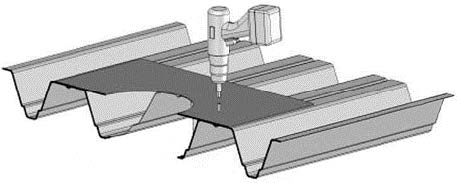
- With cast in-situ concrete decks, the roof outlet hole for should be pre-cast into the deck using formwork. The outlet is a integral component of the Bauder waterproofing system and this precaution is important to prevent damage to the outlet and the waterproof connecting flange prior to installation.
For concrete decks, the roof outlet hole (Ø 250 mm) should be pre-cast in-situ so the outlet can be installed by the roofing contractor when the waterproofing system is installed.
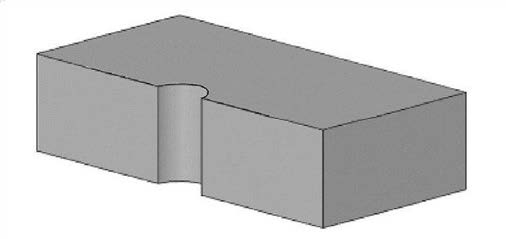
- In both instances the outlet body must be mechanically fixed to the deck.
- Roof outlets must be freely accessible for maintenance.
Installation Instructions
- Core hole through concrete deck 250mm or cast in-situ.
- Place smaller diameter EPDM gasket on to deck surface if installation is via a pre cored hole.
- Install outlet into hole sitting on top of small circular EPDM gasket.
- Mechanically fasten the outlet into substrate using the three pre-drilled holes in the polyurethane outlet flange.
- Install the first layer of Bakor 790-11 Hot Melt Waterproofing on to the first 35mm of the polyurethane outlet flange.
Note - If the first coat of Hot melt is taken further than this into the depression on the flange, it is very difficult to sit the screw flange correctly.
- Install the large 495 x 495mm EPDM Reinforcement into the hot Bakor 790-11 Hot Melt Waterproofing.
- Install the second coat of Bakor 790-11 Hot Melt Waterproofing, fully covering the EPDM reinforcement up to the edge of the outlet hole.
- Install the Bauder Protection Sheet over the hot Bakor 790-11 Hot Melt Waterproofing second coat and trim to ensure the outlet hole is clear and free from waterproofing material. The Bakor 790-11 Hot Melt Waterproofing must encapsulate the whole of the 495 x 495mm EPDM Reinforcement.
- Place the clamping ring into position ensuring it provides a physical clamp between the Bauder Protection Sheet and outlet body. Tighten the countersunk head screws supplied with a screwdriver.
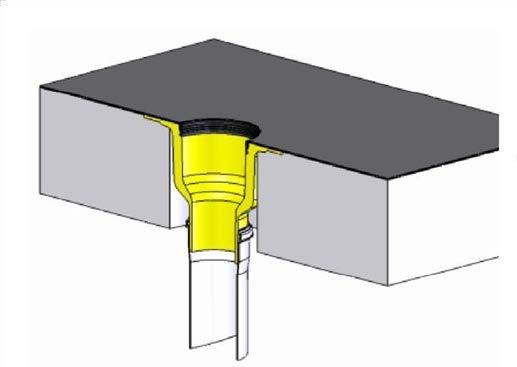
Connection to pipework
Hot Melt Compact – Insulated Vertical Outlets are suitable for connection to:
- 110 mm uPVC “O” ring socketed soil grade pipe to BS 4514: 1983
- Socketed and socket-less cast iron pipework to BS 416:1973 and EN 887. Socketed pipework will require cold caulking or PVC to cast iron adaptors. Socketless pipework can be connected using an appropriate SML mechanical coupling.
- HDPE pipework with appropriate SML mechanical coupling
Waterproofing to items of complex detailing
The application of the waterproofing system to these details will vary depending on a number of factors, including the construction sequencing, design of the protrusion i.e. balustrade base size & shape etc. Other considerations include surface levels i.e. are base plates shimmed to correct inconsistent levels, expansion joint widths, initial construction movement or anticipated post-installation movement.
Bauder Ltd can advise, design, and provide CAD drawings to illustrate the waterproofing detailing to any structure on receipt of drawings, for guidance.
Complex detailing may include:
- Balustrades
- Vent pipes
- Expansion joints
- “I” beams
- Metal upstand brackets
- Concrete stairways
- Smoke vents
- Glazing cills
A typical example of the types of very complex detailing feature that the Bakor-790-11 system is ideally suited to waterproofing.
The Application of the Membrane to the Deck Area
First Layer of Bakor 790-11
- Treat the deck surface with a coating of Bakor Polymer Primer.
- The application of the Bakor 790-11 system to the main deck area should carried out in a planned, organized manner to achieve an even monolithic application of the system across the deck.
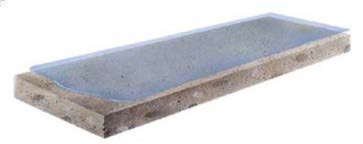
- The hot melt membrane is applied in two 3mm thick layers at the combined nominal rate of 6.5kg/m2 for the two layers. This can help the contractor to monitor the amount of product used against the area covered, to ascertain that the application rate is correct.
- Applying the GRID method is an accurate way to control the consistent application rate of the membrane across the whole area of the deck. The GRID method is the marking out of the deck into 900mm wide strips, with the use of a chalk line.
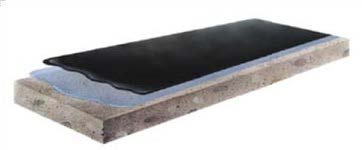
- Working methodically within each 900mm wide grid line the first 3mm layer of membrane is installed by pouring the Bakor 790-11 hot melt onto the deck and spreading it with a rubber bladed squeegee, to achieve an even coverage over the WHOLE width area within each grid line. Generally, three passes with the squeegee across the width of the grid line is sufficient to obtain an even 3mm thick layer of membrane, by the time the hot melt is setting.
Reinforcement Sheet
- When the first section of hot melt membrane has been spread and is still HOT, the relevant reinforcement layer (usually the Bauder Polyester Fleece) is carefully placed into the first layer of hot melt, and rolled out - fully bedding the fleece into the hot melt membrane, taking care not to crease it.
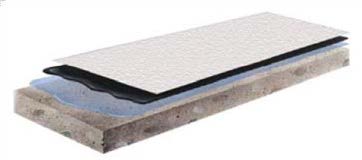
- A wide headed clean brush can be used to brush down the fleece into the hot melt ensuring it is fully bedded into the membrane with no air pockets and NO BARE AREAS OF DECK BENEATH!. Done correctly and at the right temperature the white colour of the fleece will turn grey as the bitumen starts to partially bleed through.
- Working to the prevailing weather the contractor can continue to install the first layer, grid strip by grid strip ALWAYS ENSURING that the Bakor 790-11 is lapped onto the previously installed strip, to form a completely homogeneous layer.
- The installer MUST NOT lay more of this first layer than can be safely covered by the second coating layer and its relevant access/protection layer, by the end of each day or according to the prevailing weather conditions. Although rain will not affect the exposed Polyester reinforcement, it cannot be coated until completely dry and this may hold up progress.
Second Layer of Bakor 790-11
- When applying the second layer of Bakor 790-11 membrane, the width of the installed Bauder polyester reinforcement acts as the GRID line marker.
- The second Layer of membrane MUST ALWAYS be installed on the same day as the first – NO reinforcement should be left uncovered at the end of the working day.
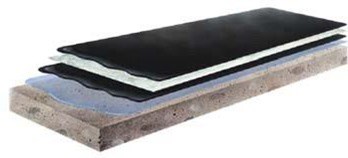
- This second coat of membrane is applied in the same manner as the first – pouring, and evenly spreading the Bakor 790-11 to a 3mm depth within each “grid line” formed by the polyester reinforcement.
- As the installation of the second layer of Bakor 790-11 progresses, the appropriate Access/Protection sheet must be bedded into the membrane while it is still HOT.
Access/Protection Layers
- For all work, whether its roofing, tanking etc the Bakor 790-11 monolithic membrane requires an access/protection layer bedded into it immediately following the application of a second 3mm layer of membrane, to protect the membrane from the trafficking and likely damage from following trades. Also to allow access onto it to install the landscape finishes i.e. insulation, paving etc.
- The type of protection layer will depend on (a) the proposed build-up and (b) the expected period of time that the system is going to be exposed to abuse from following trades.
- The types of access/protection layers approved for use with the Bakor 790-11 monolithic system are:
Bauder AP1
Bauder 2.2 mm reinforced modified bitumen membrane.
Bauder AP2
Bauder 4 mm reinforced modified mineral surfaced bitumen membrane root barrier.
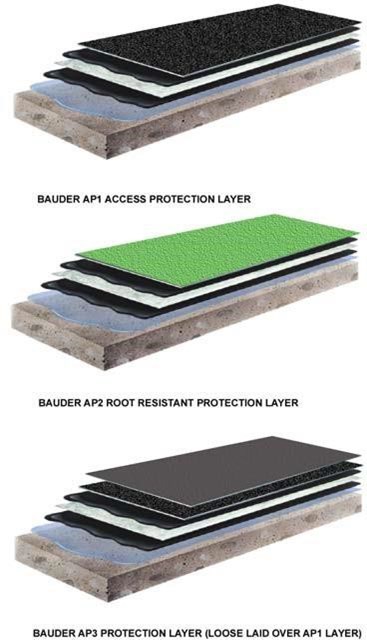
Bauder AP3
3 mm bituminized composite board.