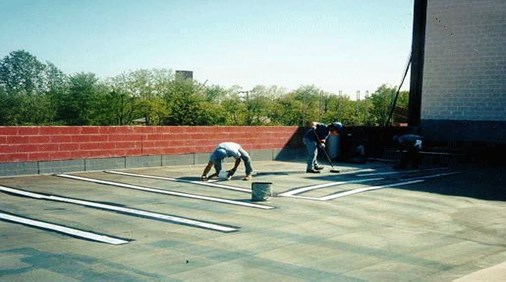
The Bakor 190-11 System Application
Manual Sections
Preparation - Bond Test Procedure for Concrete Decks
Peel Bond Tests are a useful guide to establish the cured state of the concrete deck.
As a guide, in-situ concrete can take 28 days to cure properly (60 days if concrete is poured into a structural metal tray), but the weather, concrete mix and effectiveness of curing aids will add variables to this.
Tight contract programs quite often put pressure on the Bauder Approved Contractor to waterproof before the 28 days. Generally, depending on the weather & time of year, 14 - 21 days is the earliest point for a bond test to be carried out.
In-Situ concrete can be supplied and installed in various specifications and could include additional surface treatments.
There will be good reason for these different specifications, but we must be cautious that not all variants will be compatible with the successful installation of our Bakor 790-11 waterproofing system.
If Bauder Technical are in any way concerned with the type of in-situ concrete they will request that the Bauder Approved Contractor via the Main Contractor is asked to confirm the mix of concrete and which admixes and /or Curing Compounds have been used.
The reason for this is that some admixes and Curing Compounds can be detrimental to the successful bond between in-situ concrete deck and our Bakor 790-11 waterproofing (For more information contact myself using contact details at the end of this ITB).
Surface Treatment Curing Compounds
Surface Treatment Curing Compounds, may be employed to assist in the curing of the concrete deck.
Surface Treatment Curing Compounds are used to effectively seal the surface of the in-situ concrete, which aids hydration.
The use of Surface Treatment Curing Compounds should be notified to the Bauder Approved Contractor and Bauder prior to work commencing. Upon receipt of this information we will determine if there is a need for additional surface preparation and its type.
Assuming that there are no issues with the inclusion of admixes and there are no Surface Treatment Curing Compounds we can consider the procedure for carrying out a Peel Bond Test.
For information, we are aware of only one Surface Treatment Curing Compound that may not require removal, which are SODIUM SILICATE BASED, these are recommended above any other liquid membrane curing compound for use with Hot Melt because they leave no film or residue (when properly applied) which can interfere with Hot Melt’s ability to bond to the concrete surface.
The correct conditions, confirmed by a Peel Bond Test, for applying the Bakor 790-11 Monolithic membrane is a fully cured in-situ concrete deck with a minimum density of 2100kg/m3, Wood Float or other Bauder Approved finished surface, which is dry, clean, and properly primed.
The ability of the Bakor 790-11 to bond securely to the deck, should always be checked by carrying out a Peel Bond Test. Such a test should always be conducted on each area prior to the application of the membrane. The testing should be carried out at least 48 hours in advance of the actual application, in case any remedial treatment is required, or further curing is necessary.
The Bakor 790-11 Peel Bond Test Procedure
The Bakor 790-11 Peel Bond Test procedure should follow the below sequence:-
Enough on-site time should be allowed for the Peel Bond Test process.
If using Bauder Polymer Primer this could take up to 1 and a 1/2hrs. If using Bauder QD Primer this could take up to 7 hours. These approximations are based on the maximum primer drying times which will be a variable depending on weather conditions.
Rushed Peel Bond Tests could end in unnecessary failure. Multiple test areas should be undertaken, generally in relation to the date of the pour of each section of deck or a minimum of one Peel Bond Test per 75 – 100m2.
The aim of the Peel Bond Test, is to make sure that the deck has fully cured and is ready to receive the Bakor 790-11 Waterproofing System. A fully cured deck should result in a successful Peel Bond Test, assuming the following sequence is followed.
- The surface of the concrete must be dry for the test. If there has been recent rainfall, the area of the test and at least 300mm beyond, should be squeegeed or towelled dry (or sufficient area beyond to make sure that water does not creep back into the test area). The concrete deck test area can then be dried by using a gas torch in a safe and proficient manner (If the deck is retaining too much moisture drying off the surface may not be enough for a successful test).
- Prepare the test area, but beware, over preparation could lead to a false result. Laitance, dust and loose particles should be removed, leaving the test area prepared and clean. Priming should take place immediately.
- Prime a small area of the deck being tested (approx. 500 x 500mm). The primer used should be the primer described in the J31 Bauder Specification. Bauder Primer should be evenly rollered and left to dry. Bauder Polymer Primer has a drying time of between 15 to 30 minutes, Bauder Quick Dry Primer has a drying time between 3 to 6 hours.
- Once the primer is fully dry, a small quantity (3-4mm) of Bakor 790-11 is poured onto the test area (approx. 450mm x 450mm, leaving an edge of primer showing) and firmly applied using a hard board spreader to the deck.
- Whilst the Bakor 790-11 is still hot, a piece of torch-on mineral protection layer (preferably AP2), slightly smaller than the test area (Approx 400mm x 400mm), is to be dressed and firmly bedded into the top surface of the material.
- The applied Bakor 790-11 and Protection Layer is allowed to cool. (This can take anything up to 45 - 60 minutes)
- The staggering of the Bauder Polymer Primer, Bakor 790-11 compound and Bauder Protection Layer proves that the test has been carried out using the correct products for the Bauder Approved Contractors photographic documentation.
- Once the sample has sufficiently cooled cut a triangular shaped incision through the protection layer in the test patch. Leave enough room to carry out a further triangular shaped incision 24 hrs later to check that the conclusion of the first test is sound. If the membrane can be peeled up easily from the deck, this is called an adhesion failure, which means that something is prohibiting the bond between Bakor 790-11 and deck.
The reason for this must be investigated further. Contact myself for further advice.
Possible causes are issues of contamination, laitance on the surface, certain ad-mixes, the surface is too smooth, Surface Applied Curing Compounds etc.
If the membrane is seen to be bonded to the deck and bonded to the underside of the protection sheet and legs can be seen when aggressively pulled apart, this is known as a cohesive failure and the bond is considered satisfactory.
- Photographic/ preferably video evidence of all successful Peel Bond Tests should be logged by the Bauder Approved Contractor.
- We would re-iterate that we recommend that 2 Peel Bond Tests are prepared for each area of concrete deck to be checked. One test to be carried out on the day and the second 24 – 48 hours later. This will give added assurance that there are no issues with the bond.
- Alternative methods for detecting moisture remaining in a concrete deck are as follows, these can give an early indication that moisture is present, but they will not override the requirement for a successful Peel Bond Test:
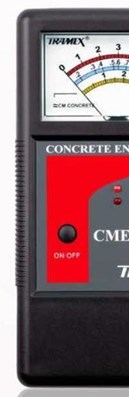
Moisture Meter (Tramex) - Resistance
- Clear easy-to-read analogue dial.
- No need to probe, drill or mechanically damage the surface.
- Instant and precise readings to a depth of approx. 20 mm into the slab.
- Non-destructive in operation.
- Reproducible results.
- Spring-loaded contact pins compensate for uneven concrete and boost signal penetration.
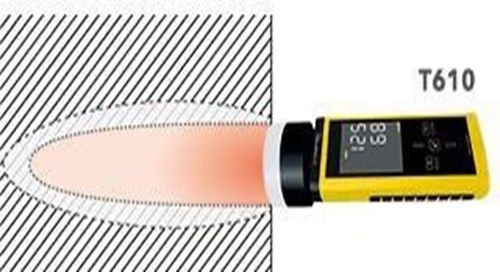
Moisture Meter (Trotec) - Microwave
- Using the T610, moisture distributions can be detected in building materials to a depth of up to 300 mm – owing to the microwave technology.
- No need to probe, drill or mechanically damage the surface.
- Non-destructive in operation.
- Reproducible results.
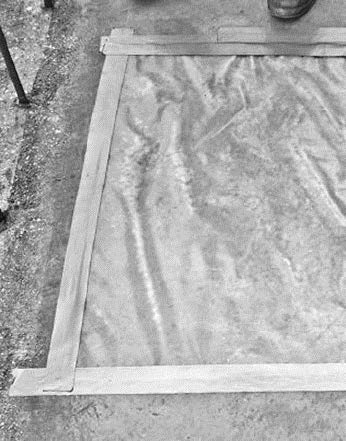
Plastic Sheet Method
- Seal 450 x 450mm square piece of plastic to “dry” deck.
- Wait 16 -24 hours (without rain on top of the sheet).
- Remove plastic sheet.
- Moisture on underside of plastic or on the concrete surface indicates wet concrete.
- Additional curing time required.
- Limitation – weather dependent.
Preparation – Cleaning and Priming the deck surface
Surface preparation
- The substrate must be dry, and clean of all surface contaminants as described earlier.
- All surface irregularities, likely to inhibit the Bakor 790-11 being laid in continuous even monolithic layer should be removed.
- The area to be waterproofed should be thoroughly swept to remove loose debris, and then blown clean with a high-pressure air hose, or industrial strength vacuum.
Priming
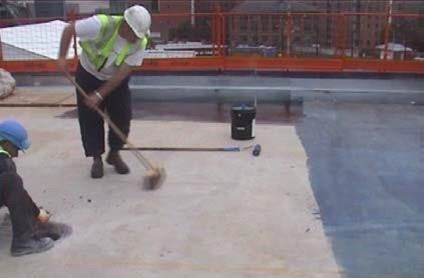
- The deck surface must be thoroughly primed with Bakor Polymer Primer. This greatly enhances the adhesion between the Bakor 790-11 membrane and the substrate.
- Bauder Polymer Primer can be either spray or roller applied, and has a coverage rate of 4 – 6 m2 per litre.
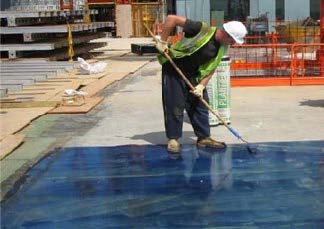
Bauder Polymer Primer has two significant advantages over ordinary bituminous primers. It dries within 30 minutes – this can help in changeable weather conditions, and speed the application process.
It also provides excellent adhesion qualities, which could be critical where the bond test has indicated possible adhesion problems.
Preparation – Cleaning and Priming the deck surface
Cracks less than 1.5mm width
- The deck surface requires no additional treatment and the Bakor790-11 membrane system is applied directly over the crack as per the specification.
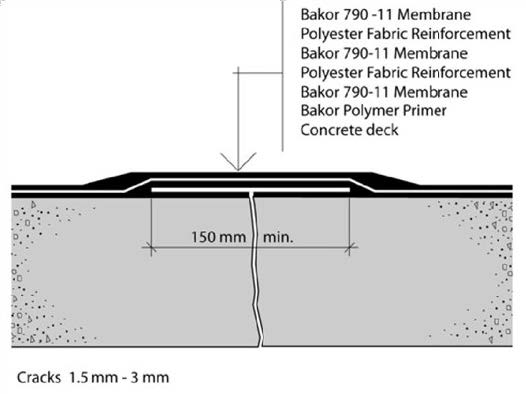
Cracks 1.5 mm – 3 mm width
- Bakor 790-11 hot melt rubberised bitumen to be applied in a minimum 3mm thickness to a width of 100mm on each side of the crack.
- Bauder Polyester Fabric reinforcement cut to a width of 150mm to be centred over the crack and then bedded into the Bakor 790-11 while it is still hot, to ensure full adhesion and partial bleed through of the bitumen.
- Bakor790-11 membrane system is applied directly over the reinforced crack as per the specification.
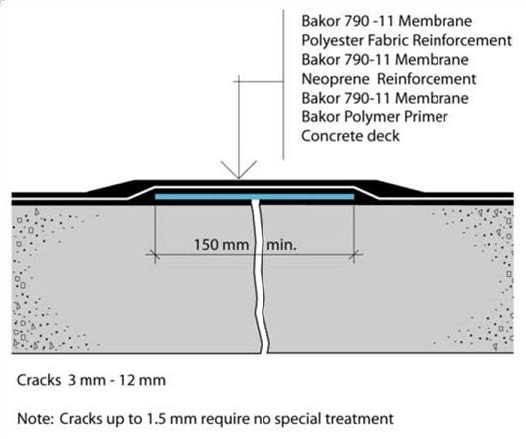
Cracks 3 mm – 12 mm width
- Bakor790-11 hot melt rubberised bitumen to be applied 3mm thick to a width of 100mm on each side of the crack.
- Bauder Neoprene Reinforcement strip, 150mm wide to be centred over the crack and bedded into the hot melt rubberised bitumen whilst it is still hot to ensure full adhesion.
- The Bakor790-11 hot melt rubberised bitumen system is then applied directly over the reinforced crack as per the specification.
The application of reinforcement taping to all shrinkage or minor structural cracks found in the deck surface.