Principles
1.1 Systems overview
Bauder’s reinforced bitumen membranes are reinforced with either polyester or glass, or both, and are manufactured from modified bitumen to give high tensile strength, flexibility, and longterm durability. Some systems accommodate options for underlayers and air and vapour control layers (AVCL). All systems are available with a choice of Bauder insulations.
BTRS PLUS
Cap sheet:
BauderKARAT, BauderSMARAGD (root resistant cap sheet)
Underlayer:
BauderTEC KSA DUO 35
AVCL:
BauderTEC KSD FBS, BauderTHERM DS 1 DUO or Bauder Super AL-E
BTRS
Cap sheet:
Bauder K5K, BauderPLANT E (root resistant cap sheet)
Underlayers:
BauderTEC KSA DUO, BauderFLEX G4E
AVCL:
BauderTEC KSD FBS, BauderTHERM DS 1 DUO or Bauder Super AL-E
Bauderflex
Cap sheet:
BauderFLEX K4E, BauderPLANT E 42 (root resistant cap sheet)
Underlayers:
BauderTEC Sprint DUO, Bauder EGV 35 TF
AVCL:
BauderTEC KSD FBS, BauderTHERM DS 1 DUO, or Bauder EVA 35
Airtech
Cap sheet:
BauderTEC KSO SN, KSO ALP SN, or KSO-P SN
Underlayers:
BauderTEC KSA DUO
AVCL:
BauderTEC KSD FBS
Note: Where there is a choice of more than one capping sheet, underlayer or AVCL, please refer to project specific specification.
1.2 Cap sheets
Bauder cap sheets are reinforced and incorporate modified bitumen to give flexibility, high tensile strength, thermal stability, and robust protection for the roof.
Mineral finish – protect the bitumen from UV radiation where the cap sheet is exposed.
Mica finish – must only be used in hard landscaping scenarios where the roof is to have ballast, promenade tiles or paving. Mineral finish capsheet must be used for flashings and details where the membrane is exposed to UV (above the height of the landscaping).
| Capping Sheet | Thickness (mm) | Roll size (wxl metres) | Weight (kg/roll) | Charcoal Grey | Grey Slate | Brown |
|---|---|---|---|---|---|---|
| Bauder KARAT | 5.2 | 1 x 5 | 30 | ✓ | ✓ | ✗ |
| Bauder K5K | 5.2 | 1 x 5 | 32.5 (Ch G) 30 (B or GS) | ✓ | ✓ | ✓ |
| BauderFLEX K5E | 5 | 1 x 5 | 29 | Mica finish | ||
| BauderFLEX K4E | 4.2 | 1 x 7.5 | 41.25 (Ch G) 37.5 (B or GS) | ✓ | ✓ | ✓ |
| Bauder PYE PV200 S4 | 4 | 1 x 10 | 50 | Mica finish | ||
| BauderTEC KSO-P SN | 4 | 1 x 5 | 23 | ✓ | ✗ | ✗ |
| BauderTEC KSO SN | 4 | 1 x 5 | 23 | ✗ | ✓ | ✗ |
| BauderTEC KSO ALP SN | 4 | 1 x 5 | 23 | ✗ | ✗ | ✓ |
| Root Resistant Capping Sheets | Thickness (mm) | Roll size (wxl metres) | Weight (kg/roll) | Green | Green/white |
|---|---|---|---|---|---|
| SMARAGD | 5.2 | 1 x 5 | 30 | ✗ | ✓ |
| PLANT E | 5.2 | 1 x 5 | 30 | ✓ | ✗ |
| PLANT E 42 | 4.2 | 1 x 7.5 | 37.5 | ✓ | ✗ |
Note: Where there is a choice of more than one capping sheet, underlayer or AVCL, please refer to project specific specification.
1.3 Underlayers
Bauder underlayers are glass reinforced and incorporate modified bitumen to give flexibility, high tensile strength, and protection for the roof prior to installation of the capping sheet.
| Underlayer | Thickness (mm) | Roll size (wxl metres) | Application | Weight (kg/roll) |
|---|---|---|---|---|
| BauderTEC KSA DUO 35 | 3.5 | 1 x 7.5 | Self-adhesive | 30 |
| BauderTEC KSA DUO | 3 | 1 x 7.5 | Self-adhesive | 26.25 |
| BauderTEC Sprint DUO | 2 | 1 x 15 | Self-adhesive | 37.5 |
| BauderFLEX G4E | 4 | 1 x 7.5 | Torch-applied | 36 |
| Bauder EGV 35 TF | 3.5 | 1 x 8 | Torch-applied | 37.6 |
1.4 Air and vapour controls layers (AVCLs)
Bauder air & vapour control layers (AVCLs) are lined with aluminium foil and act as both a vapour control layer and air tightness layer, and when fully installed provide a watertight finish at this stage of the works.
| AVCL | Thickness (mm) | Roll size (wxl metres) | Application | Weight (kg/roll) |
|---|---|---|---|---|
| BauderTEC KSD FBS | 2.5 | 1.08 x 10 | Self-adhesive | 27 |
| BauderTHERM DS 1 DUO | 3.5 | 1.08 x 7.5 | Self-adhesive | 36.45 |
| Bauder Super AL-E | 3.5 | 1 x 7.5 | Torch-applied | 33.75 |
| Bauder EVA 35 | 3.5 | 1 x 8 | Torch-applied | 36 |
1.5 Safe2Torch
Flame-free zone areas
- It is always the responsibility of the contractor to carry out a risk assessment on all aspects of the project contract to identify and appropriately catalogue the location of combustible materials used in the construction of the flat roof to ensure that operatives are fully aware.
- The NFRC Safe2Torch checklist should be used for guidance when assessing a flat roof for the location of combustible materials and hazardous zones.
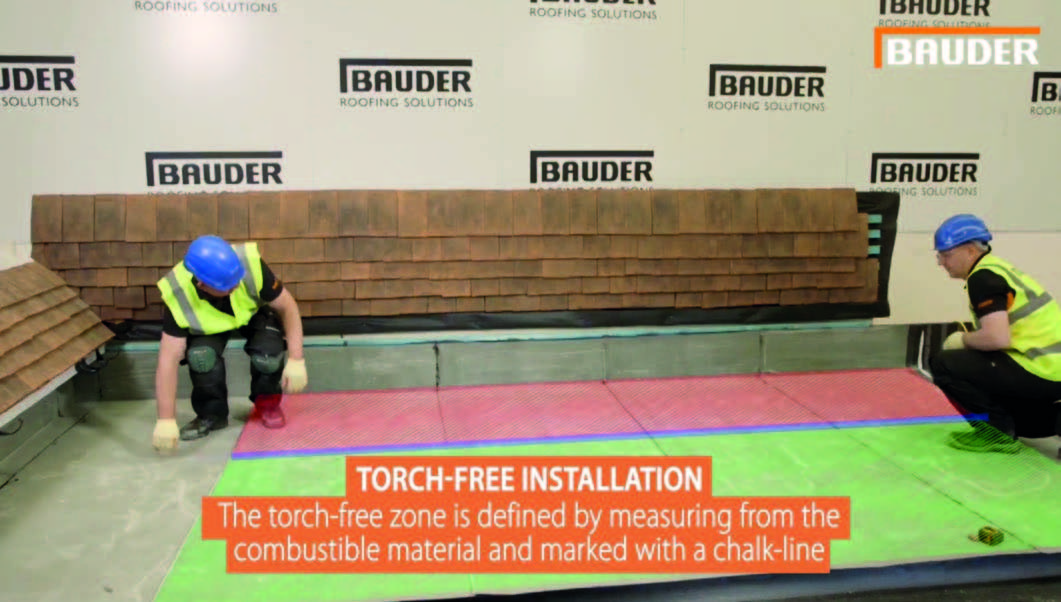
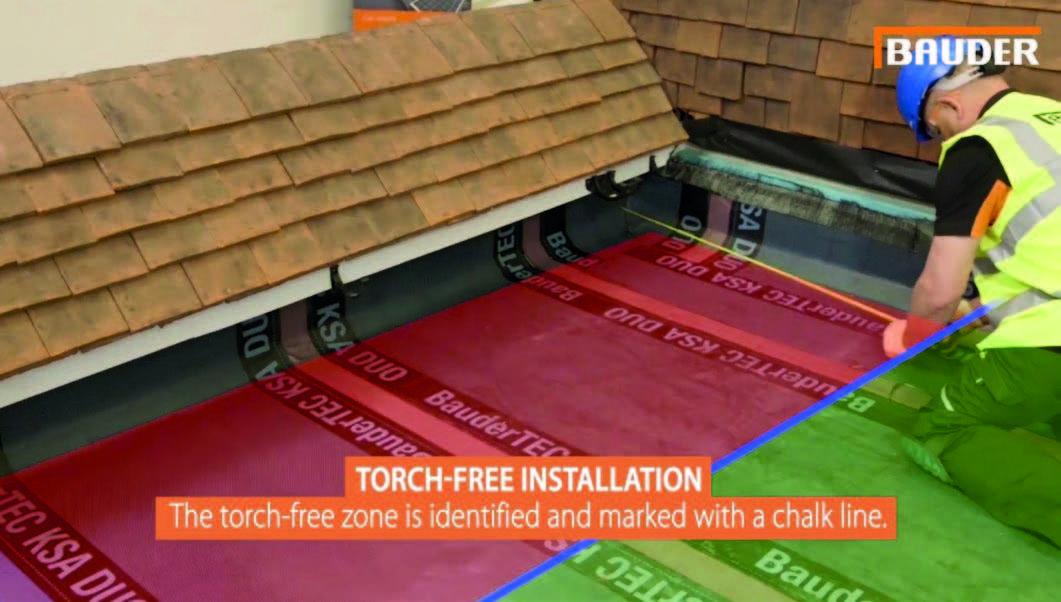
- Gas torches MUST NOT be used within at least 900 mm of the area around any combustible material used to construct the roof and their use must conform to safe systems of work.
- Flame-free or flame-safe detailing MUST be employed using the appropriate Bauder self-adhesive membrane as detailed in the Bauder project specification and further detailed in the Bauder flame-free and Bauder bituminous detail drawings.
- Refer to the Bauder project specific roof plan, specification and/or survey report and associated photographs of specific details for areas requiring flame-free application.
1.6 Delivery and storage
Check delivery upon the receipt of the goods against the delivery note. Bauder will not be liable for further costs in the case of subsequent deliveries if it is later discovered that any material is missing or damaged.
Bauder waterproofing membranes
All rolls of bituminous waterproofing membranes should be stored on end to prevent deformation, which makes the product more difficult to install.
Self-adhesive membranes must be stored out of direct sunlight as the self-adhesive properties of the membrane are reduced when exposed to UV radiation. The function of the release film on the underside of the membrane could also be affected if stored in direct sunlight.
During periods of warm weather, all mineral finish capping sheets should be protected from excess heat as this may bring oils in the bitumen to the surface and cause staining of the mineral, giving a darker appearance. This washes off following rainfall but can cause temporary discolouration.
Bauder insulation boards
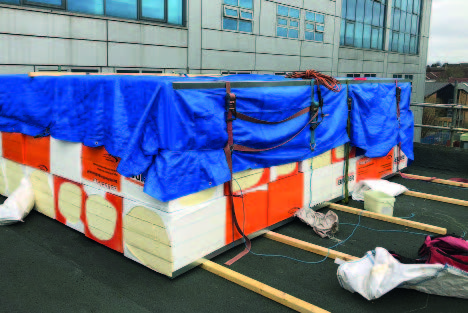
All insulation boards must be kept dry, on pallets and off the ground. The packaging of Bauder insulation products should not be considered adequate for weather protection. The boards should be stacked clear of the ground and covered with suitable robust UV resistant, flame-retardant tarpaulin.
Insulation boards that have been allowed to get wet should be allowed to dry naturally before being used.
If glass tissue faced boards facings become damp or wet, then they must be allowed to fully dry out before use, otherwise there is a likelihood that they will delaminate from the board during the application of the underlayer. In addition, entrapped moisture within the board will lead to degradation of the insulation and loss of thermal performance will occur over time.
Primers and adhesives
The products should be stored in a secure storage cage, unopened, in a dry condition and at a temperature stated on the Technical Data Sheet and/or Safety Data Sheet. This will ensure the stated shelf-life.
Note: Products may have a limited life once the container is opened, refer to Technical Data Sheet.
RBM membranes
Store the materials outdoors, on end/upright and off the ground with suitable robust UV resistant, flame-retardant tarpaulin. Ensuring the product(s) are clear of buildings and any other storage areas. Where there are storage containers on site, these may be suitable for storing products.
Insulation boards
Store the materials outdoors with suitable robust UV resistant, flame-retardant tarpaulin. Ensuring the product(s) are clear of buildings and any other storage areas.
All insulation boards must be kept dry, on pallets and off the ground. The packaging of Bauder Insulation products should not be considered adequate for weather protection.
The products must not be exposed to a direct naked flame or other ignition sources, or to solvents or other chemicals.
Where there are storage containers on site, these may be suitable for storing products.
1.7 Packaging and labelling
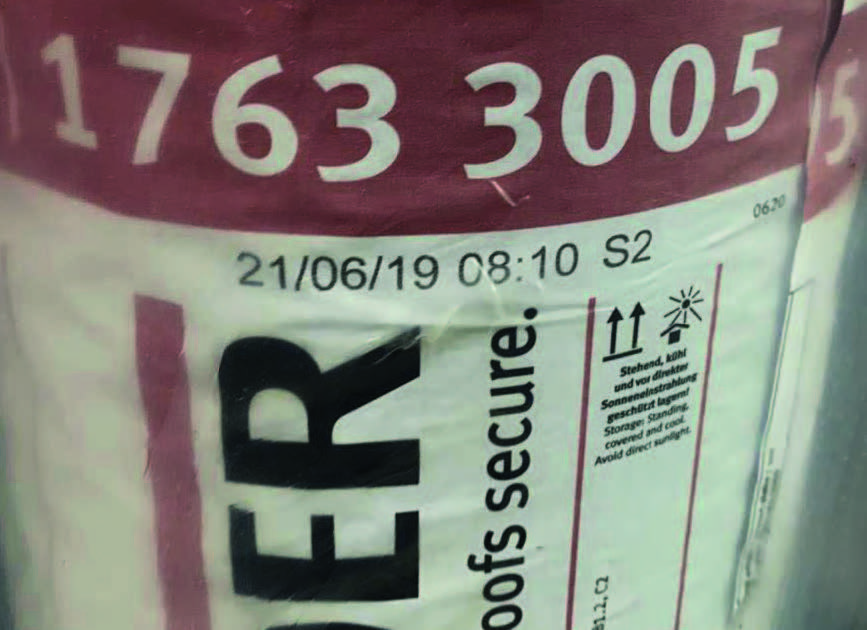
Every roll of bitumen membrane will have a label which includes key information about the membrane; importantly it also includes the production batch number highlighted in the orange rectangle.
This reference is important for identifying and cross referencing against where and when the batch was manufactured, should it be required.
1.8 Installation precautions
Cutting products - products should not be cut directly on installed membranes and a suitable protection board should be used to protect them, e.g. plywood.
Hot works permit will be be required for the installation of the membranes.
1.9 Kit list
Documentation
- NBS J41 or Bauder standard format specification.
- CAD detail drawings – standard, flame-free (where applicable), and project specific.
- Tapered insulation scheme layout for the project, where applicable.
- U value calculation(s), drainage calculation(s), wind load calculation(s) where applicable.
Basic tools
- Craft knife equipped with hooked blade for cutting membranes.
- Craft knife equipped with straight blade for cutting peel-off release film from underside of self-adhesive products.
- Chalk line for setting out and aligning sheets. Marking alignment – tapered insulation, flashings etc.
- Hand roller.
- Tape measure.
- Hand saw.
- Hammers.
- Wire brush.
- Appropriate PPE.
- Metal cutting saw equipped with a hardened blade for cutting BauderGLAS Insulation.
- Trowel/scraper.
- Straight edge to aid cutting membranes.
- Fire extinguishers.
Gas torches – only used for torch-safe detailing and lap welding
- Not used for System Airtech or flame-free detailing.
- All torches must have a support stand, adjustable pressure regulator (set at a suitable pressure), and safety gas cut off valve.
- Torches should comply with Safe2Torch guidelines and fitted with an electronic ignition so no pilot flame is left on.
- Long handled torch for torch-applied products to the flat areas.
- Short-handled torch for torch-safe detail work.
- With SBS modified membranes, it is important to use a torch that does not have an over-large burner head and too high a pressure setting. Over-torching can damage the membranes.
- Sievert electronic ignition gas torches are available to purchase or hire from:
James Lister & Sons Limited
Tel: 0121 553 2949
Email: [email protected]
Cutting Insulation boards
- Where boards must be cut, it is best practice to use a proprietary, cordless insulating material saw with guide rail; this may be used for polyisocyanurate (PIR) and stone mineral wool, or a hot wire cutter for expanded polystyrene (EPS) and extruded polystyrene (XPS).
- The use of handsaws with flexible blades is not advised due to the lack of consistency to leave a straight, square edge and the consequential heat loss.
- Where practical, thermal insulation boards should be installed from the perimeter of a flat roof towards the centre to avoid cuts around the perimeter.
1.9 Kit list continued
Hot air welding equipment for flame-free areas and System Airtech installation
- 240 volt electrical supply required from either a direct connection to the building’s mains power installed and disconnected (once works are complete) by a qualified electrician.
If electrical supply is via a generator a 10 KVA output is required. For further advice contact either:
LCH Generators
T: 02476 361 333
M&J Engineers Ltd
T: 01462 429 311 - If required and upon request, refer to Bauder guidance sheet including diagrams on electrical installation and a document covering the health and safety recommendations relating to using 240 Volt portable electrical equipment on site.
- The hot air gun’s temperature should be set between 500 - 550º C to ensure the bitumen is sufficiently activated.
- Nozzles for the hot air guns should be 40 mm for hand held tools and 80 mm in size for automated equipment.
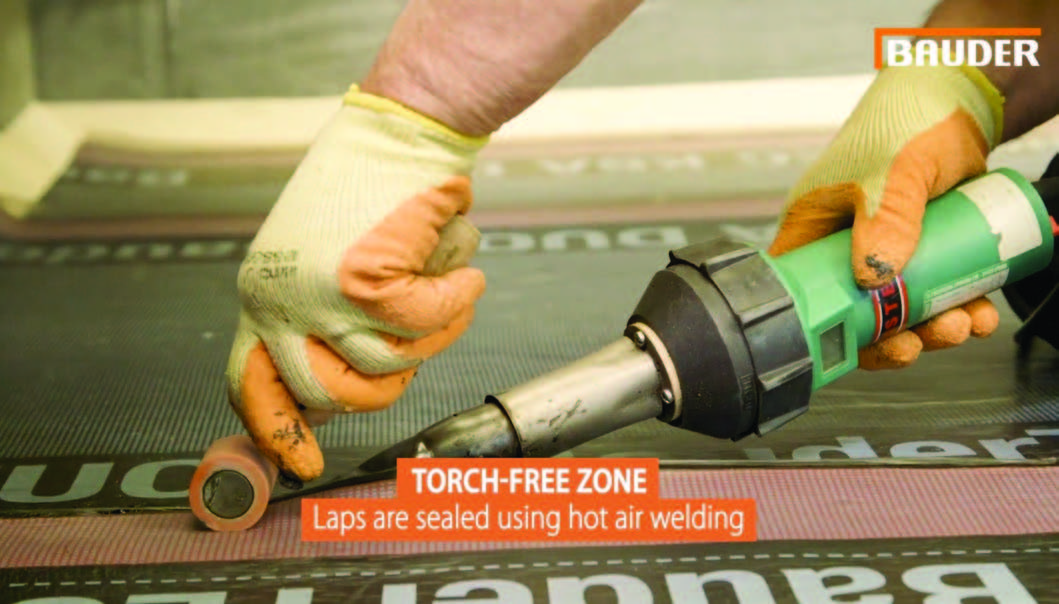
Suitable hot air welding equipment manufactured by ‘either’:
LEISTER HOT AIR WELDING TOOLS -
Welwyn Tool Group
T: 01707 331 111
W: www.welwyntoolgroup.co.uk
James Lister & Sons Limited
T: 0121 553 2949
E: [email protected]
W: www.liser.co.uk
ETORCH MAX
Imperial Thermal Engineering Ltd
T: 01376 330582
W: www.imperialthermal.co.uk
Specialist equipment
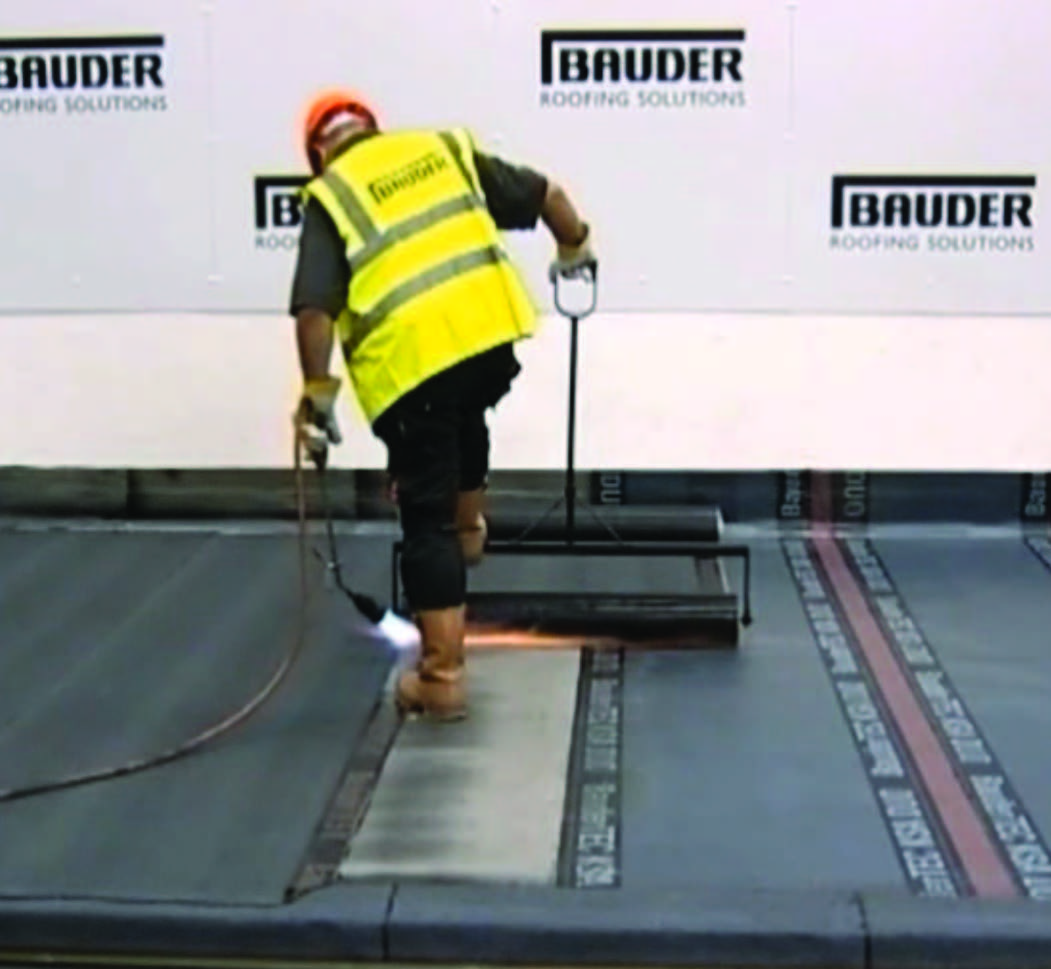
Bauder exclusively supplies specialist equipment to assist the installation of its bitumen membrane systems.
- Bauder roll bar with removable spindle (System Airtech requires spindle only) whereby the weight of the roll bar helps to evenly spread the bitumen flow across the roll.
- The operative can clearly see the bitumen flow and adjust and control the application speed to suit and achieve a neat, even, bitumen bead extrusion from all the lap joints. This is especially important when applying mineral surfaced capping sheets.
- Unsightly foot marks in the newly laid and still hot material can be avoided by walking backwards (where safe to do so) in front of the membrane, rather than walking directly on the membrane being applied.
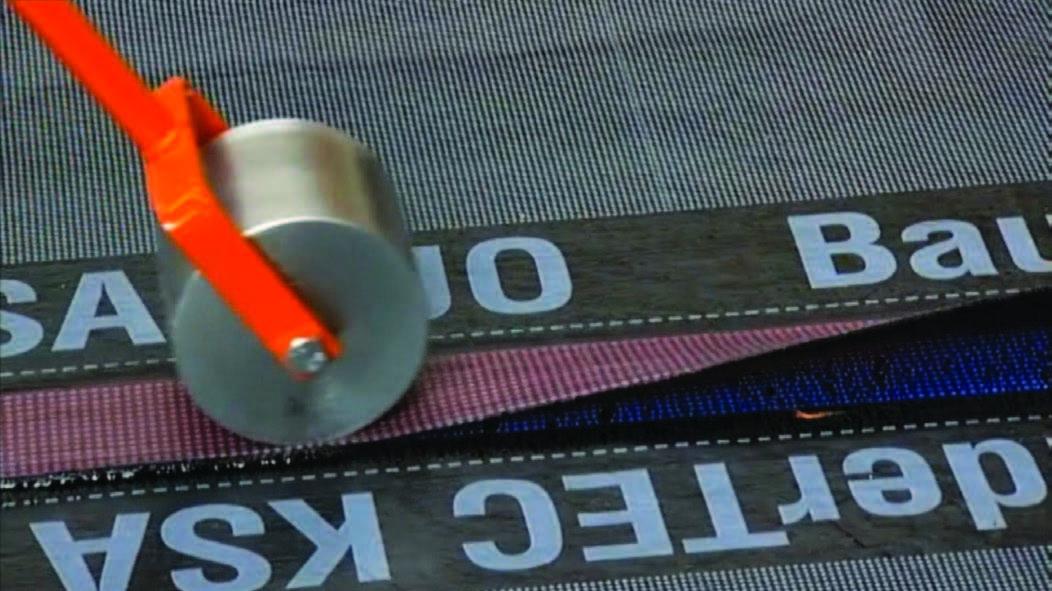
- Bauder long handled lap roller - necessary for the installation of ‘DUO’ products.
- Used within a two-man operation whereby one operative activates the bitumen whilst the other uses the long-handled roller to apply pressure.
- Ensures a neat bead of bitumen to be extruded out of the lap for a successful lap joint.
- Provides a fast method of lap sealing.
- A lap joint sealed with a pressure roller is much stronger.
1.10 Operative training
Bauder reinforced bitumen membrane systems are only permitted to be installed by operatives who have been successfully assessed and trained by Bauder site technicians.
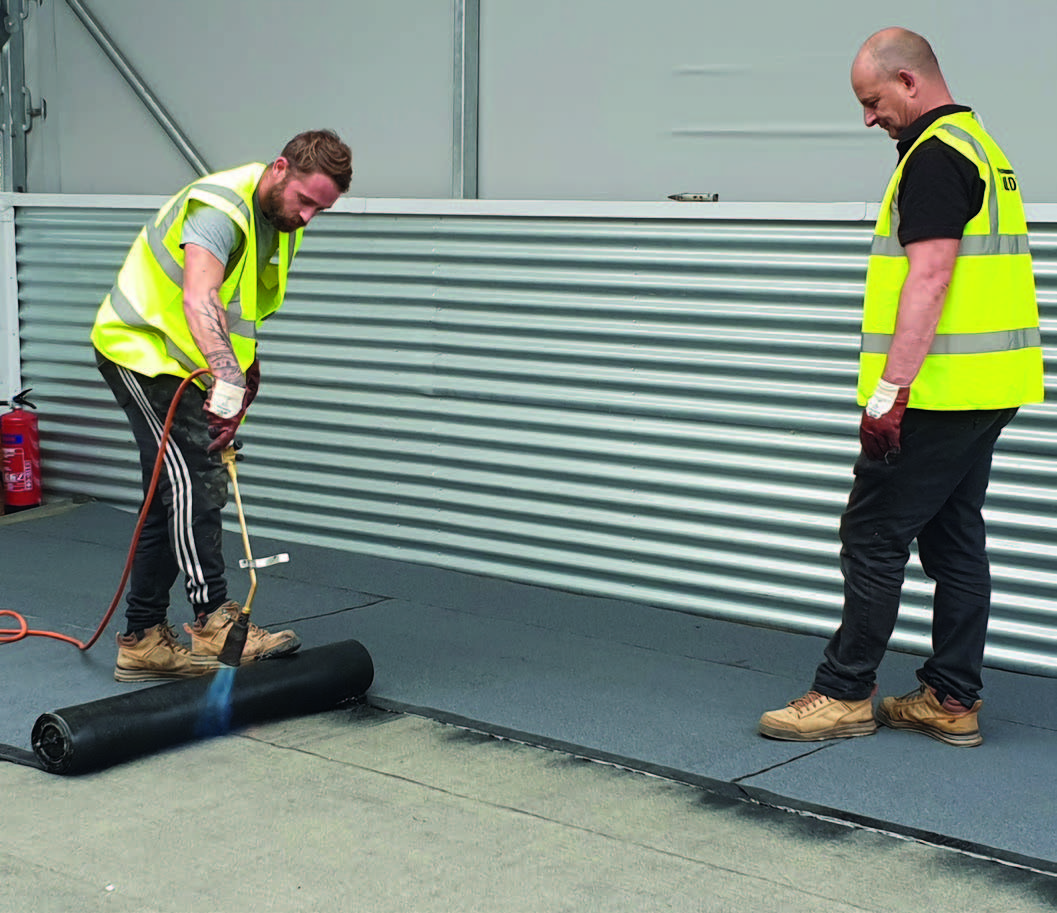
Fully certified operatives:
- Have satisfied the application requirements and specification criteria while under instruction.
- Will carry a certified installer card or digital card detailing the Bauder systems in which they are approved.
- Should be able to produce their Certified Installer Card or digital card at any time, as a form of identification, when requested by any party with an interest in the roofing work.
Provisionally certified operatives will be:
- Experienced operatives who are provisionally certified are permitted to install the system but will be assessed on-site for a limited period by the Bauder site technician.
- Upgraded to ‘fully certified’ when Bauder is satisfied with the quality and consistency of their work, and their card issued.
1.11 Recycling and disposal of waste
Canister adhesives & primers
- Once a canister is no longer expelling adhesive or primer, then transfer the hose and gun to a new canister. Open the valve on the new canister and purge the adhesive/primer through the hose and gun.
- Open the valve at the top of the used canister and empty any remaining adhesive/primer and propellant into a suitable container.
- Ensure the valve remains open. Leave for at least 1 hour.
- Use a non-ferrous rod and mallet to strike the bursting disk at its perimeter.
- Remove the disk, which will reveal an aperture. This will ensure that the canister remains depressurised.
- Leave for 24 hours to allow any residue adhesive/primer to dry and/or cure.
- After this procedure has been followed, the canister will be empty of any hazardous materials and depressurised. Therefore, it can be considered as scrap metal in accordance with the national or local waste company, under code EWC 150104 (empty aerosol, no hazardous residues).
- Canisters that are still pressurised and contain adhesive/primer should be disposed of in accordance with the national or local waste company under code EWC 160504 (full or partially empty aerosol).
Drum or tin adhesives
- Empty containers should be treated as controlled waste. Dispose of waste to licensed waste disposal site in accordance with the requirements of the local Waste Disposal Authority.
Bituminous membranes
- Bituminous membranes and off cuts can be sent for disposal with household waste. EWC code 170302 'asphalt tar-free' (comply with local authority regulations).
- Bitumen membrane rolls are wrapped in protective paper and some rolls have a cardboard core for stability. Full pallets have further wrapping to ensure stability of the rolls in transit. It is important that protective strapping and wrapping is kept in place until the membrane is about to be installed.
- All packaging is readily recyclable at most transfer centres.
Insulation offcuts
- Rigid polyurethane foam waste can be disposed of with household waste or commercial waste similar to household waste (European waste catalogue EWC number 170604 ‘insulation material’).
BauderROCK:
- Disposing of any waste material must be carried out in accordance to national regulations.
BauderGLAS:
- BauderGLAS Insulation is recyclable. Off-cuts need to be disposed via an authorised disposal contractor to an approved waste disposal site, observing all relevant regulations.
Gas cylinders
- Some local authorities accept gas bottles at household waste recycling centres. Please check with staff at the recycling centre where the bottles should be left so they can be stored safely before being re-used. Generally they would be re-filled at your local gas filling centre.